Skip the research trap. Get your propellers in 60 seconds.
We scored 300+ propellers across 5 dimensions — answer 5 quick questions and we'll match you to YOUR best pick.

Powered by DecisionScore™
Each product is evaluated across 18 weighted criteria — covering performance, value, build quality, and real-world usability. Your quiz answers re-weight the criteria to match what matters most to you, so two people can get different #1 picks from the same data.
See the DecisionScore methodology →- Hurricane 51499 – designed for high-speed FPV racing stability
- Stays steady through low gates and split-S drops
- Extremely durable PC – bends back after crashes
Find your perfect propellers
5 quick questions. No quiz-takes-10-minutes trap. A personalized match from 30 scored picks — with clear reasoning for every recommendation.
What type of vehicle are these propellers for?
Different vehicles need very different propeller designs—FPV drones, camera drones, RC airplanes, and RC boats each have unique requirements.
- FPV drones need 3–5 inch crash-resistant props, while camera drones use larger, quieter folding blades.
- RC airplanes use 9–16 inch props, often in wood or glass-fiber for efficiency and low vibration.
- RC boats require short, high-pitch, three-blade props—usually 2–4 inch metal or reinforced plastic.
As an Amazon Associate and affiliate partner we earn from qualifying purchases. Links on this page may earn us a commission at no extra cost to you. Full disclosure
Not ready for the quiz? Here are our overall top picks
These are our top-rated picks overall. For a recommendation matched to YOUR specific needs,
16pcs Fpv Drone Props Propeller: Gemfan Hurricane 51499 Tri-Blade 5 Inch Props
Hurricane 51499 – designed for high-speed FPV racing stability
View Today's Price![[20 pcs] GEMFAN 5" Propeller 51466V2, 5 inch High Performance 3-Blades Props for](https://m.media-amazon.com/images/I/41lONSspmzL._SL500_.jpg)
[20 pcs] GEMFAN 5" Propeller 51466V2, 5 inch High Performance 3-Blades Props for
5-inch 3-blade props for FPV racing quadcopters
View Today's Price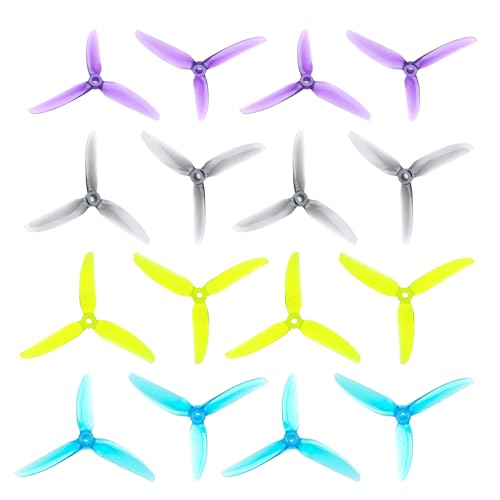
16pcs Fpv Drone Props Propeller: HQProp V2S 5x4.3x3 Tri-Blade 5 Inch Props for
5-inch tri-blade polycarbonate prop in high-vis yellow
View Today's PriceHow to Choose the Right Propellers
Choosing the right propeller depends on your vehicle type, material preference, prop size, blade count, and budget—trade-offs that shift based on your flying style and crash tolerance. A feature that’s perfect for aggressive FPV racing can be totally wrong for a camera drone or RC airplane. Our recommendation engine evaluates your specific setup across five key dimensions and matches you to the ideal propeller in under 60 seconds.
About this guide
Propellers
Why Propeller Choice Is Trickier Than It Looks
Most buyers underestimate how much a propeller swap can make or break your drone, RC airplane, or boat experience. The trade-offs are real: a $10 polycarbonate FPV propeller might survive a dozen crashes, while a $15 beechwood XOAR airplane propeller could lose efficiency after just 30 windy flights. Sizing is another minefield—pick a 13x4.5 propeller when your motor needs a 16x7, and you’ll see sluggish climbs or even burn out your ESC. Budget is deceptive, too: $12 for a Master Airscrew propeller pair seems steep until you realize sub-$5 generic propellers often arrive unbalanced, causing vibrations that ruin bearings and footage. Many DJI owners splurge on OEM multi-packs, not realizing Master Airscrew’s $25 third-party propeller sets match factory performance and add features like TPU tips. The biggest mistake? Ignoring blade count and pitch. A two-blade propeller maximizes speed, but a tri-blade propeller gives you the stability needed for aggressive FPV freestyle. The right propeller isn’t just about price or brand—it’s about matching propeller specs to your exact flying or boating style.
What Actually Separates the Best Propellers
The real differentiators between propellers aren’t always what you expect. Polycarbonate dominates FPV drone propellers for a reason: it bends instead of shattering, so Gemfan and HQProp propellers last longer than brittle ABS or even carbon fiber propellers in real-world crashes. For RC airplanes, Master Airscrew’s glass-fiber composite propeller blades deliver a strength-to-weight ratio that generic plastic propellers can’t touch. XOAR’s beechwood propellers are the gold standard for fixed-wing pilots chasing minimal vibration and maximum aerodynamic efficiency, but don’t bother if you fly in gusty conditions—wood propellers wear out fast. Skip four-blade propellers unless you’re building a cinewhoop or ducted quad; for most, tri-blade propellers hit the sweet spot of grip and efficiency. Quick-release hubs and dynamic balancing (as seen on Master Airscrew’s DJI replacement propellers) are worth the premium for camera drones, especially if you swap propellers often. Don’t chase carbon fiber propellers for everyday flying—they’re lighter but far more brittle and rarely survive a hard hit. Focus on matching propeller size and pitch to your motor’s KV and frame clearance, not just what’s trending.
How to Decide: Interacting Factors That Matter Most
Propeller selection is a balancing act between vehicle type, material, size, blade count, and budget—all of which interact. For example, a 5-inch tri-blade polycarbonate propeller is perfect for FPV freestyle, but disastrous on a lightweight camera drone that needs quieter, more efficient 6–9 inch folding propellers. Your motor’s KV rating dictates safe propeller diameter and pitch; ignore this and you risk overheating or poor flight times. Budget constraints push you toward bulk packs, but be wary: cheap propellers are often poorly balanced, causing vibrations that can damage motors or ruin video. The quiz evaluates your vehicle, material preference, size, blade count, and budget to narrow the field of propellers. Beyond that, consider how often you crash (polycarbonate propellers for FPV, glass-fiber propellers for RC planes), whether you need quick-swap hubs (a must for DJI propellers), and if noise or vibration is a dealbreaker. Don’t forget: buying 2–3 matched propeller sets is smarter than singles, especially for multi-rotors, and always check for at least 4-star ratings with 100+ reviews before clicking buy.
Buyer's guide
How to choose
1Core Performance Criteria
- Always match propeller diameter and pitch to your motor’s KV rating—using the wrong size can cause motor overheating or poor flight efficiency.
- Polycarbonate props from brands like Gemfan and HQProp offer the best crash resistance for FPV drones, surviving far more impacts than brittle ABS or carbon fiber.
- For RC airplanes, glass-fiber composite propellers such as Master Airscrew’s Electric Only Series provide superior thrust and flight duration compared to generic plastic blades.
- Beechwood props from XOAR deliver exceptional aerodynamic efficiency and minimal vibration, but are best reserved for calm, fixed-wing applications.
- Tri-blade (three-blade) props offer increased stability and grip for aggressive maneuvers, while two-blade props maximize speed and battery efficiency.
- Quick-release hubs and dynamic balancing, as found on Master Airscrew’s DJI replacements, make prop swaps faster and improve overall flight smoothness.
2Build Quality and Durability
- Polycarbonate propellers flex rather than shatter, making them ideal for crash-prone FPV flying and extending usable life well beyond cheaper plastics.
- Glass-fiber composite props, such as those from Master Airscrew, resist warping and maintain balance longer than standard ABS or nylon alternatives.
- Beechwood props from XOAR are precision-balanced and minimize vibration, but can wear out quickly in windy or damp conditions—expect less than 50 flights in harsh weather.
- Avoid sub-$5 generic props, which often arrive poorly balanced and prone to cracking, leading to increased vibration and premature motor wear.
- Look for reinforced hub designs and thick root sections on larger airplane props to prevent mid-flight flex or breakage during high-thrust maneuvers.
- Check for at least 4-star ratings and 100+ reviews to ensure real-world reliability and consistent manufacturing quality in 2026.
3Value Analysis and Price Tiers
- The sweet spot for quality RC and drone propellers is $10–$15 per pair, with Master Airscrew and HQProp offering the best balance of price and performance.
- Bulk packs of 16 props (8 CW + 8 CCW) from Gemfan or HQProp provide excellent value for crash-prone FPV pilots needing frequent replacements.
- Premium DJI-compatible props with quick-release hubs and TPU tips cost $20–$30 per set, but often outperform OEM bundles in both durability and noise reduction.
- Avoid sub-$5 propellers, as they frequently suffer from poor balance and inconsistent molding, leading to increased vibration and lower flight quality.
- Wooden XOAR props, priced around $10–$15 each, are worth the investment for fixed-wing enthusiasts prioritizing smooth, efficient flight over raw durability.
- Glass-fiber and reinforced nylon props offer 20–30% longer lifespan than basic plastic at only a small price premium, making them a smart upgrade.
4Use-Case Fit and Application
- FPV freestyle and racing drones benefit most from 5-inch tri-blade polycarbonate props, maximizing grip and crash resistance for aggressive flying.
- Camera drones like DJI Mini or Air series require 6–9 inch folding props with precise balancing and quick-release hubs for smooth, quiet footage.
- RC airplanes perform best with glass-fiber composite or beechwood props in the 10–16 inch range, matching motor specs for optimal thrust and efficiency.
- RC boats demand short, high-pitch, three-blade props—typically 2–4 inch metal or reinforced plastic—for rapid acceleration and precise maneuvering.
- Buyers flying in windy or harsh conditions should avoid wooden props, as they wear out quickly and lose efficiency after repeated exposure.
- Always check your vehicle’s manual for recommended prop sizes and materials, as mismatches can cause poor performance or even hardware damage.
5Common Mistakes and Pitfalls
- Choosing the wrong propeller diameter or pitch for your motor’s KV can lead to sluggish performance, overheating, or even permanent motor damage.
- Buying single replacement props instead of matched sets often results in imbalance and vibration, especially for multi-rotor drones and airplanes.
- Ignoring material differences—such as picking cheap ABS instead of polycarbonate—leads to more frequent breakage and higher long-term costs.
- Failing to balance new props before installation is a top cause of in-flight vibration and noisy footage, even with reputable brands.
- Assuming all aftermarket DJI props are equal—only Master Airscrew and select third-party brands match OEM performance and dynamic balancing in 2026.
- Overlooking the impact of blade count on flight style—two-blades for speed, tri-blades for stability—results in disappointing handling or battery drain.
6Maintenance and Longevity
- Inspect propellers for chips, cracks, or warping after every flight—minor damage can quickly escalate to catastrophic failure in the air or on water.
- Balance each new propeller with a dedicated tool before use, as even factory-fresh props from top brands can have slight imbalances.
- Polycarbonate and glass-fiber props last 20–30% longer than basic plastics, but still require regular replacement after hard crashes or visible wear.
- Wooden props should be stored in dry, cool environments and replaced at the first sign of swelling or surface wear to maintain efficiency.
- Replace all props in a set at the same time to maintain balance and prevent uneven thrust or vibration across motors.
- Keep spare sets on hand—especially for FPV and RC racing—so you’re never grounded by a cracked or lost prop during a session.
FAQ
Frequently asked questions
Is it worth paying extra for Master Airscrew or XOAR propellers compared to generics?
Absolutely, especially in 2026. Master Airscrew and XOAR propellers offer consistently better balance, durability, and performance than sub-$5 generics. Generic props often arrive unbalanced, causing vibration that can damage motors or ruin video. XOAR’s beechwood props are precision-balanced for smooth fixed-wing flight, while Master Airscrew’s glass-fiber composites last 20–30% longer than basic plastics. The extra $5–$10 per set pays off in reliability and less frequent replacement, making them a smart investment for serious pilots.
How do Gemfan and HQProp compare for FPV drone propellers?
Both Gemfan and HQProp dominate the FPV market in 2026, but they have subtle differences. Gemfan props are known for their crash resilience and slightly more flexible polycarbonate, making them ideal for freestyle and beginners. HQProp offers stiffer, more responsive props that advanced racers prefer for precise control. Both brands offer excellent value in bulk packs, but if you prioritize durability over ultimate responsiveness, Gemfan is the safer bet. For pure racing, HQProp’s stiffer feel gives you an edge.
What propeller size and pitch do I need for my RC airplane?
Always match your propeller size and pitch to your motor’s KV rating and the manufacturer’s recommendations. For electric RC airplanes, Master Airscrew’s 8.5x6 or XOAR’s 16x7 beechwood props are popular choices—8.5x6 works for 1000–1400KV motors, while 16x7 suits larger, lower-KV setups. Using the wrong size can cause sluggish climbs or risk motor burnout. Always check your manual and, when in doubt, opt for a slightly smaller prop to avoid overloading your electronics.
Do I need to balance new propellers before use?
Yes, even top-tier props from XOAR, Master Airscrew, or Gemfan can arrive slightly unbalanced. Use a prop balancer tool before your first flight—80% of vibration complaints stem from factory imbalances. Balanced props reduce noise, improve efficiency, and extend motor life. It’s a quick process that pays off in smoother video, longer flights, and less wear on your gear. Skipping this step is one of the most common mistakes pilots make, especially with bulk or budget props.
Are aftermarket propellers safe for DJI drones?
Aftermarket props from reputable brands like Master Airscrew are safe and often add features like TPU tips or improved balancing. However, avoid ultra-cheap generics, as poor fit or balance can cause vibration and even void your warranty. In 2026, Master Airscrew’s DJI replacements closely match OEM performance and include quick-release hubs. Stick to brands with strong reviews and avoid any propeller that feels loose or requires force to install. Always test hover after installation to check for vibration.
How long do wooden propellers last compared to polycarbonate or glass-fiber?
Wooden props, like XOAR’s beechwood series, excel in calm, fixed-wing flight but wear out faster—often under 50 flights in windy or damp conditions. Polycarbonate and glass-fiber props typically last 20–30% longer, especially in crash-prone or variable weather scenarios. If you fly in tough conditions or crash frequently, polycarbonate is the best value. For smooth, vibration-free flight on RC airplanes, wood is still king, but expect to replace them more often than composite alternatives.
What’s the best value: buying singles or bulk packs?
Bulk packs are the clear winner for FPV and multi-rotor pilots in 2026. Sets of 16 props (8 CW + 8 CCW) from Gemfan or HQProp cost $10–$15 and ensure you always have balanced replacements. Buying singles or mismatched pairs often leads to vibration and uneven wear. For RC airplanes or boats, matched pairs or sets are still preferable for balance and performance. Always buy at least two full sets upfront to avoid downtime and maintain consistent flight quality.
Best Propellers By Category
Related Guides
Beginner CNC Routers
Project type, assembly comfort, upgrade needs, and support—get matched to the right CNC router for your skills and ambitions.
Beginner Telescopes
Skill level, observing targets, portability, and setup preferences—get matched to the right beginner telescope for your skywatching style.
Calipers
Matched to your measurement type, accuracy needs, shop environment, and workflow—find the caliper that truly fits your projects.
Desktop 3D Scanners
Matches you to the right scanner based on object size, precision, workflow, colour needs, and how you’ll actually use it.
3D Printer Filament
Matched to your project type, printer, experience, and budget—find the right filament for every print.