Skip the research trap. Get your standing desks in 60 seconds.
We scored 300+ standing desks across 5 dimensions — answer 5 quick questions and we'll match you to YOUR best pick.
Powered by DecisionScore™
Each product is evaluated across 18 weighted criteria — covering performance, value, build quality, and real-world usability. Your quiz answers re-weight the criteria to match what matters most to you, so two people can get different #1 picks from the same data.
See the DecisionScore methodology →Find your perfect standing desks
5 quick questions. No quiz-takes-10-minutes trap. A personalized match from 26 scored picks — with clear reasoning for every recommendation.
What best describes your workspace setup?
- Measure your available floor space and leave room for chair movement and walking paths.
- Consider how many monitors, speakers, or peripherals you plan to use regularly.
- Think about whether your workspace might change or expand in the next year.
As an Amazon Associate and affiliate partner we earn from qualifying purchases. Links on this page may earn us a commission at no extra cost to you. Full disclosure
Not ready for the quiz? Here are our overall top picks
These are our top-rated picks overall. For a recommendation matched to YOUR specific needs,
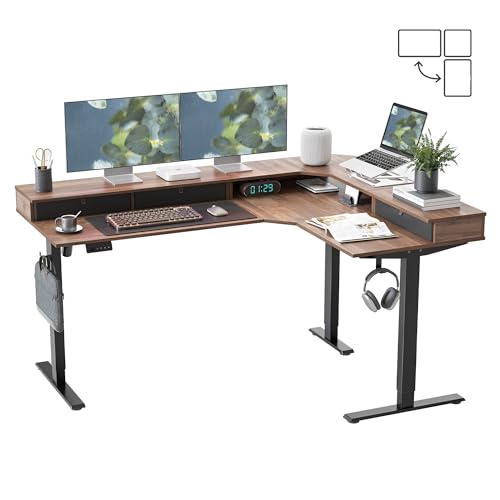
FEZIBO L Shaped Electric Standing Desk, 63x48 inch Large with Drawers |

FEZIBO Standing Desk, 48 × 24 Inches Electric Height Adjustable, Sit and Stand

FLEXISPOT E6 Pro Oval Leg Dual Motor 3 Stages Standing Desk 48x30 Inch
How to Choose the Right Standing Desks
Choosing the right standing desk depends on how your workspace size, ergonomic needs, material preferences, and integrated features interact—trade-offs that shift based on your specific setup. Generic top-10 lists fail because a desk perfect for a compact home office might be a disaster for a multi-monitor creative rig. Our recommendation engine evaluates your unique requirements across five dimensions and matches you to the right standing desk in under 60 seconds.
About this guide
Standing Desks
Why Standing Desk Choices Are More Complex Than They Seem
Standing desks in 2026 are not just about picking between sitting and standing—they’re about matching your workflow, equipment, and space to a dizzying array of specs and features. The trade-offs are real: a $200 single-motor desk may look tempting, but it often struggles with stability and can’t handle the weight of dual monitors or heavy peripherals. On the other end, a $900 executive-grade model like the Herman Miller Jarvis offers a 350lb weight capacity and a 1.5"/sec lift speed, but that’s overkill for a laptop-only setup. Most buyers get tripped up by focusing on desktop size or finish, overlooking critical specs like motor type (single vs. dual vs. triple), height range (especially for users over 6ft—51+ inches is a must), and anti-collision features that prevent costly accidents. Integrated features—drawers, wireless charging, cable trays—can make or break your daily experience, but they’re not standard across all price tiers. The biggest mistake? Assuming any desk will fit your workflow. In reality, the wrong choice leads to wobble, limited adjustability, or a style that clashes with your space.
What Actually Sets Standing Desks Apart in 2026
The real differentiators in standing desks now go far beyond surface material or basic adjustability. Brands like FlexiSpot have raised the bar with three-motor systems (E7L) for ultra-smooth, stutter-free lifts, while models like the Uplift V3 and Herman Miller Jarvis stand out for rock-solid stability and advanced programmable controls. Skip single-motor desks unless your setup is truly minimal—they simply can’t keep up with multi-monitor or creative rigs. Prioritize anti-collision detection, now standard on FlexiSpot E7 and Uplift V3, to protect your devices and workspace. For taller users, a max height of at least 51 inches (as on the Jarvis) is non-negotiable. Material matters: laminate is the most scratch-resistant and easy to clean, while bamboo and solid wood offer style at a price. Don’t be fooled by flashy extras—integrated wireless charging and drawers are only worth it if you’ll actually use them. Ultimately, stability, motor quality, and real-world adjustability matter more than any single aesthetic feature.
How to Weigh Your Needs and Make the Right Choice
Choosing the right standing desk means understanding how your workspace size, equipment load, style preferences, and budget interact. A compact apartment setup calls for a small, stable desk—possibly a FlexiSpot EN1 or Branch Duo—while a multi-monitor creative rig demands a heavy-duty frame like the FlexiSpot E7 Plus or Uplift V3. Material choice isn’t just about looks: laminate offers durability and easy cleaning, bamboo brings sustainability, and solid wood delivers a premium feel but requires more care. Your budget sets real boundaries—under $400 means sacrificing some stability and features, while $500–$900 unlocks advanced motors, anti-collision, and customization. Features like cable management, wireless charging, and programmable presets are essential for some, but unnecessary for others. Our quiz evaluates your workspace, style, feature priorities, adjustability needs, and unique workflow traits in five focused questions. The key is to balance what you truly need with what you’ll actually use—don’t pay for features you’ll ignore, but don’t skimp on stability or height range if your setup demands it.
Buyer's guide
How to choose
1Core Performance Criteria
- Choose a standing desk with at least dual motors, like the Uplift V3 or FlexiSpot E7, for smooth, quiet, and reliable height adjustments under daily use.
- Prioritize anti-collision technology, now standard on FlexiSpot E7 and Uplift V3, to protect your devices and avoid costly accidents during adjustments.
- Ensure the desk’s height range suits your stature—models like the Herman Miller Jarvis reach 51 inches, crucial for users over six feet tall.
- Look for programmable presets, which allow instant transitions between sitting and standing; most premium models offer at least three memory slots.
- Check for weight capacity of at least 200 lbs for multi-monitor setups; the Jarvis handles up to 350 lbs, while budget models may struggle over 150 lbs.
- Adjustment speed matters for workflow—premium desks like the Jarvis offer 1.5 inches per second, minimizing disruption when changing positions.
2Build Quality and Durability
- Select desks with T- or C-shaped legs, such as the FlexiSpot E7 Plus, for superior stability and reduced wobble at maximum height, especially on carpeted floors.
- A thick, one-piece desktop—at least 1.5 inches—adds rigidity and minimizes flex, as seen in Uplift V3 and premium FlexiSpot models.
- Frames made from heavy-gauge steel last longer and resist sway; avoid lightweight aluminum frames found in ultra-budget options.
- Check for high-quality control panels with discrete paddles or OLED displays; bulky or cheap buttons are prone to accidental presses and faster wear.
- Brands like Uplift and Herman Miller back their desks with extensive warranties, reflecting confidence in long-term build quality and parts durability.
- Assembly quality varies—look for models with clear instructions and pre-drilled tops, which reduce setup time and risk of misalignment.
3Value Analysis
- Mid-range desks like FlexiSpot E7 and E7 Plus, priced $500-$700, deliver premium stability and features without the executive price tag of Herman Miller Jarvis.
- Budget options under $400, such as VIVO or FEZIBO, may suffice for light use but often sacrifice motor smoothness and long-term reliability.
- Uplift V3, typically $600-$900, justifies its price with customization, stability, and a robust warranty, making it a smart investment for daily users.
- Watch for sales—Herman Miller Jarvis occasionally drops 25%, bringing executive-grade features into mid-range budgets for a limited time.
- Evaluate included features; some brands charge extra for cable management or memory presets, which are standard on FlexiSpot E7 series.
- The best value is found where essential features—stability, anti-collision, and programmable controls—meet your budget, not in chasing every possible add-on.
4Use-Case Fit
- Compact desks like the Branch Duo or smaller FlexiSpot models excel in tight spaces, offering 36-inch surfaces ideal for apartments or dorm rooms.
- For multi-monitor or creative setups, prioritize desks with 48-inch or larger tops and 200+ lb capacity, such as the ApexDesk Elite Pro Series.
- If you share your desk, look for programmable presets and wide height ranges; FlexiSpot E7 accommodates multiple users with ease.
- Gaming or heavy-peripheral users should seek triple-motor designs and robust frames, like the FlexiSpot E7L, to prevent stutter and sway.
- Minimalist users may prefer clean, cable-free designs—Uplift V3 offers optional grommets and under-desk trays to keep clutter at bay.
- If frequent moves are likely, consider portable or folding models, but accept trade-offs in stability and weight capacity compared to fixed-frame options.
5Common Mistakes to Avoid
- Don’t choose based on desktop size alone—frame design and leg shape matter far more for long-term stability and user comfort.
- Many buyers underestimate the importance of height range; desks under 51 inches max can be unusable for users over six feet tall.
- Avoid single-motor desks for heavy setups; they often stutter or fail under load, especially with multiple monitors or accessories.
- Assuming all desks include anti-collision or cable management is risky—verify these features before purchasing, as they’re absent in many budget models.
- Neglecting to measure your workspace leads to regret; always check both desktop dimensions and required clearance for full height adjustment.
- Overlooking warranty length and support can cost you—premium brands like Uplift and Herman Miller offer peace of mind not found with lesser-known brands.
6Maintenance and Longevity
- Regularly inspect and tighten bolts, especially after moving or adjusting the desk, to maintain rock-solid stability and prevent wobble over time.
- Clean the desktop with non-abrasive cleaners matched to the material—laminate, bamboo, or solid wood—to preserve appearance and avoid surface damage.
- Check motor operation monthly; listen for unusual noises or uneven movement, which may indicate wear or the need for lubrication.
- Keep cable management trays clear of dust and debris to prevent overheating or accidental snags that could damage electronics or the desk’s mechanics.
- Adhere strictly to manufacturer-stated weight limits; exceeding capacity shortens motor lifespan and can void warranties, especially on budget frames.
- If your desk includes programmable controls, periodically reset or recalibrate them per the manual to ensure accurate height memory and smooth operation.
FAQ
Frequently asked questions
Is paying extra for triple-motor standing desks really worth it?
Triple-motor standing desks, such as the FlexiSpot E7L, provide smoother and more reliable height adjustments, especially under heavy loads like dual monitors and storage accessories. If your setup is demanding or you frequently change heights, the extra investment pays off in reduced stutter, increased stability, and longer motor life. For light laptop use, dual-motor models suffice, but for professional or creative workstations, triple-motor designs are a smart upgrade in 2026.
How does the Uplift V3 compare to the FlexiSpot E7 for daily use?
Both the Uplift V3 and FlexiSpot E7 are highly rated for stability and smooth adjustment. The Uplift V3 stands out for its extensive customization options and robust frame, while the FlexiSpot E7 offers excellent value and standard anti-collision technology. For most users, the FlexiSpot E7 is a solid mid-range choice, but if you want more finish options or advanced controls, the Uplift V3 justifies its higher price in 2026.
What height range should I look for if I'm over six feet tall?
If you're over six feet tall, prioritize standing desks with a maximum height of at least 51 inches. The Herman Miller Jarvis, for example, reaches 51⅛ inches, accommodating taller users comfortably. Many budget desks max out at 48 inches, which can lead to poor ergonomics and discomfort. Always check the full height specification before buying, as proper fit is essential for long-term comfort and productivity.
Are budget standing desks under $400 reliable for everyday work?
Budget standing desks under $400, like those from VIVO or FEZIBO, can be suitable for light use or single-monitor setups. However, expert reviews warn that these models often suffer from instability, limited weight capacity, and shorter lifespans. For daily work or heavier setups, investing in a mid-range model like the FlexiSpot E7 or Uplift V3 is recommended for better stability, smoother motors, and longer-term reliability in 2026.
How does Herman Miller Jarvis justify its premium price?
The Herman Miller Jarvis commands a higher price due to its exceptional build quality, 350lb weight capacity, and ultra-smooth lift speed of 1.5 inches per second. Its wide height range (25⅝–51⅛ inches), OLED programmable controls, and robust warranty make it ideal for demanding users or shared workspaces. While mid-range desks cover most needs, the Jarvis excels for those who value top-tier durability, adjustability, and long-term support.
Is anti-collision detection a must-have feature?
Anti-collision detection is highly recommended, especially if you have pets, children, or valuable equipment under your desk. This feature, standard on models like FlexiSpot E7 and Uplift V3, automatically stops the desk if it encounters resistance, preventing costly accidents. While some budget desks omit this, it’s a small investment for peace of mind and device safety in 2026’s busy home and office environments.
Can I use a standing desk converter instead of a full standing desk?
Standing desk converters, like the VIVO DESK-V000K, are a budget-friendly way to add sit-stand functionality to an existing desk. However, expert reviewers warn they often lack stability for multi-monitor setups and can wobble at full extension. For lightweight laptop use or occasional standing, converters work, but for daily productivity or heavier setups, a full frame-and-top standing desk is the better long-term solution.
Related reading
Best Standing Desks By Category
Related Guides
3D Printers
Matched to your print size, detail needs, materials, and how much you want to tinker or automate.
All-in-One Laser Printers for Home Office
Matched to your print volume, color needs, workflow features, and budget—get the right laser all-in-one for your home office.
Sit-Stand Desk Converters
Matched to your desk size, equipment weight, ergonomics, and feature preferences—get the right converter for your workflow.
Budget and Mid‑Range Laptops
Matched to your main tasks, OS preference, portability, and display—find a laptop that fits your real workflow and budget.
Color Laser Printers
Matched to your print volume, connectivity, and cost priorities—find the color laser printer that fits your workflow and space.