Skip the research trap. Get your high-end studio lighting kits in 60 seconds.
We scored 350+ high-end studio lighting kits across 5 dimensions — answer 5 quick questions and we'll match you to YOUR best pick.

Powered by DecisionScore™
Each product is evaluated across 18 weighted criteria — covering performance, value, build quality, and real-world usability. Your quiz answers re-weight the criteria to match what matters most to you, so two people can get different #1 picks from the same data.
See the DecisionScore methodology →- GVM 1000D 2-pack RGB LED panels with 2 softboxes
- 18 applicable lighting scenes
- Bluetooth app control for both lights
Find your perfect high-end studio lighting kits
5 quick questions. No quiz-takes-10-minutes trap. A personalized match from 35 scored picks — with clear reasoning for every recommendation.
What is your primary use for the lighting kit?
Different uses require different light characteristics. Video needs flicker-free continuous output; photography benefits from both strobe and continuous; streaming needs compact, app-controllable lights; product photography needs soft, even, color-accurate light.
- Portrait and still photography benefit from soft, diffused light and accurate color rendering.
- Video production requires flicker-free, quiet lights with adjustable color temperature for different scenes.
- Live streaming often needs compact, app-controlled panels or ring lights for easy setup and real-time adjustments.
As an Amazon Associate and affiliate partner we earn from qualifying purchases. Links on this page may earn us a commission at no extra cost to you. Full disclosure
Not ready for the quiz? Here are our overall top picks
These are our top-rated picks overall. For a recommendation matched to YOUR specific needs,
GVM 1000D RGB Led Video Light with 2 Softboxes, Photography Lighting Kit with
GVM 1000D 2-pack RGB LED panels with 2 softboxes
View Today's Price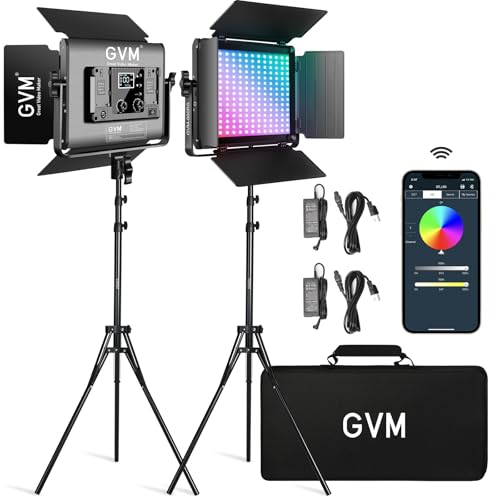
GVM RGB LED Video Light with Bluetooth Control, 60W Photography Studio Lighting
2-pack GVM 880RS 60W RGB LED panels with softboxes
View Today's Price
GVM RGB Photography Lighting Kits with 2 Softboxes, 880RS 60W Studio Lights with
3-pack GVM 880RS 60W RGB LED panels with 3 softboxes
View Today's PriceHow to Choose the Right High-End Studio Lighting Kits
Choosing the right high-end studio lighting kit depends on how your use case, modifier preference, budget, color temperature needs, and kit size interact—trade-offs that shift based on your workflow and space. A feature that’s perfect for portraiture might be wrong for video or streaming, and a budget-friendly kit often sacrifices build quality or color accuracy. Our recommendation engine evaluates your specific needs across five dimensions and matches you to the best-fit lighting kit in under 60 seconds.
About this guide
High-End Studio Lighting Kits
Why High-End Studio Lighting Is Tricky: Real Trade-Offs and Buyer Pitfalls
Choosing high end studio lighting kits in 2026 is more nuanced than it appears. The biggest trap? Chasing raw power or flashy RGB features without considering color fidelity—CRI 95+ and TLCI 97+ ratings are non-negotiable if you want accurate skin tones and true-to-life product shots. Many buyers fixate on wattage or the number of included lights in high end studio lighting kits, but overlook the importance of stable stands and Bowens-mount compatibility, which determine what modifiers you can actually use. Price tiers are stark: $200 high end studio lighting kits (like entry NEEWER softboxes) seem tempting, but often wobble at full height or suffer from color shifts after 30 minutes of use. Move up to $500–$1,200, and you unlock bi-color adjustability, Bluetooth app control, and robust build quality from brands like Godox, GVM, and Elgato. Most buyers underestimate how much smart control—like wireless remotes or app-based dimming—affects real-world workflow with high end studio lighting kits. The most common mistake? Buying a single-light kit when a two-light setup is essential for balanced key/fill ratios in high end studio lighting kits. Don’t let a low price or a long feature list distract you from the specs that actually matter for your type of work when evaluating high end studio lighting kits.
What Actually Separates Top Kits: Specs, Brands, and Real Performance
The real differentiators in high end studio lighting kits for 2026 aren’t just about output or color temperature range—they’re about how reliably and flexibly you can shape your light. Kits with CRI 97+ and TLCI 97+ (like those from Godox and GVM) outperform cheaper alternatives for both video and photo, especially in skin tone rendering. Skip RGB panels in high end studio lighting kits unless you need creative effects; bi-color (2700K–7500K) is more useful for matching ambient light. Bowens-mount COB heads are a must in high end studio lighting kits if you want to use pro modifiers—E26 socket kits (NEEWER, RALENO) are fine for beginners, but limit your upgrade path. App control isn’t just a gimmick: GVM’s Bluetooth system or Elgato’s desktop integration save time and let you tweak high end studio lighting kits mid-shoot. Quiet fans (under 35dB) are crucial for video—ignore “silent” claims in high end studio lighting kits unless you see real specs. Don’t get distracted by bundled accessories; a wobbly stand or poor diffusion will ruin your setup, no matter how many gels or bags are included in high end studio lighting kits. If you shoot both photo and video, prioritize continuous COB high end studio lighting kits with high CRI and Bowens compatibility over cheap strobe-only sets.
How to Choose: Decision Factors and Interactions That Matter
Your ideal high end studio lighting kits depend on how your needs, space, and budget interact. Room size and shooting style affect how much power (150W vs 300W) and light spread you need—small home studios can’t accommodate giant softboxes or heavy-duty stands found in some high end studio lighting kits. If you’re doing video, flicker-free continuous output and quiet operation are crucial in high end studio lighting kits, while product photographers need precise color accuracy and soft, even diffusion. Budget is a hard constraint: under $500, expect trade-offs in stand stability or app connectivity in high end studio lighting kits; $800–$1,200 unlocks pro features like DMX control, Bowens-mount COB heads, and multi-light high end studio lighting kits. The quiz evaluates your use case, modifier preference, budget, color temperature needs, and kit size to match you to the right high end studio lighting kits. Don’t underestimate how one factor—like needing bi-color for mixed lighting—can rule out entire classes of high end studio lighting kits. Always verify compatibility: not all “softbox” high end studio lighting kits accept pro modifiers, and not all panels are truly flicker-free for high-speed video. Think about portability if you shoot on location—some high end studio lighting kits weigh over 20 lbs. The right choice is the one that fits your workflow, not just your wishlist for high end studio lighting kits.
Buyer's guide
How to choose
1Core Performance Criteria
- Prioritize CRI 95+ and TLCI 97+ ratings for true-to-life color, especially for skin tones and product photography in 2026.
- Look for bi-color adjustability (2700K–7500K) if you shoot in mixed lighting environments; fixed 5600K is fine for daylight-only setups.
- Flicker-free continuous output is essential for video—avoid kits without verified flicker specs if you do slow-motion or high-frame-rate work.
- Choose at least 150W output for studio portraits and 300W for group shots or large sets; underpowered kits limit creative options.
- App control (Bluetooth or Wi-Fi) lets you adjust brightness and color remotely—GVM and Elgato excel here, saving time on set.
- Quiet fans (under 35dB) are crucial for video; noisy kits like some NEEWER panels can ruin audio in small studios.
2Build Quality and Durability
- Stable aluminum stands are non-negotiable—cheap collapsible models wobble above 75 inches, risking your gear and ruining shots.
- Bowens-mount compatibility ensures you can use professional modifiers; E26 socket kits limit your upgrade path and flexibility.
- Look for reinforced softboxes with double diffusion layers to prevent sagging and hotspots during long shoots.
- Check for UL certification and robust power supplies—overheating LEDs (common in older 5700K bulbs) cause color shifts and shorten lifespan.
- Premium kits like Godox UL150II and Nanlite Forza 300B II feature metal housings and weather-resistant designs for reliable location use.
- Warranty length matters—expect at least 2 years from reputable brands in the $800–$1,200 range.
3Value Analysis and Price Tiers
- The sweet spot for high-end kits in 2026 is $800–$1,200, offering bi-color, app control, and pro build quality without overpaying for unused features.
- Entry-level kits ($200–$350) from NEEWER or RALENO are tempting, but often compromise on stand stability and long-term color accuracy.
- Mid-range kits ($500–$800) like GVM’s LED panels bundle app control and high CRI, making them a solid value for hybrid shooters.
- Premium kits above $1,500 (Aputure Nova P300c, Profoto B10) offer unmatched output and RGBWW, but are overkill unless you need full studio control.
- Look for bundled deals with stands, softboxes, and carrying cases—these can save up to 20% versus piecing together components separately.
- Watch for Q2 sales, where high-end kits drop by 25%, making it the best time to buy in 2026.
4Use-Case Fit and Customization
- Portrait photographers benefit from softbox LED kits with Bowens mounts for maximum modifier flexibility and soft, flattering light.
- Video producers need flicker-free, bi-color, and app-controlled panels—GVM and Elgato are strong choices for streaming and interviews.
- Product shooters should prioritize high CRI/TLCI ratings and even diffusion to avoid color casts and harsh reflections.
- On-location shooters require portable, battery-powered kits with durable cases and weather-resistant builds—Godox and Nanlite excel here.
- Ring light kits are best for beauty, close-up, and content creation, but lack the versatility of panel or COB systems.
- Always buy at least a two-light kit for professional key/fill setups; single-light kits limit your creative control and depth.
5Common Mistakes and Pitfalls
- Don’t assume all softboxes are equal—cheap models often leak light or sag, creating uneven exposure and hotspots.
- Ignoring Bowens-mount compatibility can lock you out of using pro modifiers, limiting your creative options as you grow.
- Underestimating the importance of stand stability leads to frustrating setups—wobbly stands are the top complaint in user and expert reviews.
- Assuming high wattage guarantees quality—poor CRI or flicker issues can ruin both photo and video, regardless of output.
- Skipping bi-color or app control to save money often leads to regret when you need to match ambient or adjust remotely.
- Buying a single-light kit is a false economy; two-light setups are essential for balanced, professional-looking results.
6Maintenance and Longevity
- Clean LED panels and softbox diffusion regularly—dust buildup reduces output and can cause color shifts over time.
- Check and tighten stand joints and locking mechanisms monthly to prevent collapse or wobble during shoots.
- Monitor fan noise and temperature—overheating can degrade LED lifespan and drop CRI below 95 after extended use.
- Store kits in padded, weather-resistant cases to prevent damage during transport, especially for location work.
- Replace bulbs or LED modules only with manufacturer-approved parts; off-brand replacements can void warranties and reduce color accuracy.
- Document serial numbers and warranty info for all major components—premium brands like Godox and GVM offer two-year coverage if you register.
FAQ
Frequently asked questions
Is bi-color adjustability worth paying extra for in studio lighting kits?
Yes, bi-color adjustability (typically 2700K–7500K) is absolutely worth the premium for most users in 2026. It allows you to match your lighting to ambient conditions—daylight, tungsten, or mixed environments—without the need for gels or filters. This flexibility is crucial for interviews, product shoots, and hybrid photo/video work. Kits like the GVM LED panels and Godox UL150II offer smooth bi-color transitions, making them far more versatile than fixed 5600K models. If you shoot in a single controlled environment, you can save money with fixed daylight, but most buyers benefit from bi-color.
How does Godox compare to NEEWER for high-end studio lighting kits?
Godox and NEEWER target different segments in 2026. Godox’s high-end kits—like the UL150II—offer Bowens-mount compatibility, higher CRI (96+), and robust app control, making them ideal for serious photo and video work. NEEWER’s kits, such as their 700W equivalent softbox sets, are more budget-friendly but often use E26 sockets and can suffer from stand instability and color shift after long sessions. If you want professional flexibility and durability, Godox is the clear winner, while NEEWER is best for entry-level or occasional use.
What CRI/TLCI ratings should I look for in a studio lighting kit for video?
For video work, always look for CRI ratings of at least 95 and TLCI ratings of 97 or higher in 2026. These metrics ensure accurate color rendering, especially for skin tones and product details. Lower ratings can introduce unwanted color casts and make post-production correction difficult. Top kits from brands like Godox, GVM, and Nanlite consistently meet or exceed these standards. Avoid any kit that doesn’t publish both CRI and TLCI specs—if they’re missing, it’s usually a red flag.
Are app-controlled lights like GVM and Elgato reliable for professional shoots?
App-controlled lights from GVM and Elgato have matured significantly by 2026 and are now reliable for most professional applications. GVM’s Bluetooth app allows real-time adjustment of brightness and color temperature, which is a huge time-saver during shoots. Elgato’s Key Light integrates seamlessly with desktop and mobile platforms, ideal for streamers and video creators. However, occasional connectivity issues can occur, especially on iOS 19+ devices, so always test your setup before critical shoots. For most users, the convenience and flexibility far outweigh the rare hiccup.
How many lights do I need for a professional portrait or interview setup?
For professional portrait or interview setups in 2026, a minimum of two lights is strongly recommended—one for the key and one for fill. This allows you to control shadows and create depth, resulting in a more polished, dimensional look. Three-light setups add a background or rim light for even more control, but two is the baseline for professional results. Single-light kits are only suitable for basic headshots or product work and often produce flat, unflattering images.
What are the most common issues with budget studio lighting kits?
Budget studio lighting kits—especially those under $350—often suffer from stand instability, overheating LEDs, and inconsistent color accuracy. Stands may wobble at full extension, risking your gear and ruining shots. LEDs can overheat after 30+ minutes, causing color shifts and reduced CRI. Poor diffusion materials lead to hotspots and uneven lighting. Brands like NEEWER and RALENO offer affordable options, but these compromises are why most experts recommend investing in mid-range or high-end kits for serious work.
Are premium kits like the Aputure Nova P300c or Profoto B10 worth it for home studios?
Premium kits like the Aputure Nova P300c and Profoto B10 deliver unmatched output, color accuracy, and build quality, but they’re often overkill for typical home studios in 2026. These kits excel in commercial and broadcast environments, offering RGBWW output, advanced app control, and robust construction. For most home users, mid- to high-end kits from Godox, GVM, or Nanlite provide 90% of the performance at a fraction of the price. Only invest in ultra-premium gear if you need maximum creative control or work in demanding production settings.
Best High-End Studio Lighting Kits By Category
Related Guides
Action Cameras Buying Guide
Matched to your adventure style, budget, portability needs, and the features you’ll actually use—no more guessing.
Camera Drones
Matched to your footage style, portability, camera quality, and how long you want to fly per charge.
Advanced DSLR Cameras
Matched to your shooting style, sensor format, portability, video needs, and autofocus speed—get the right camera for your real workflow.
Beginner Drones
Matched to your flying style, risk tolerance, budget, and camera needs—get the right beginner drone for how you’ll actually fly.
Beginner Mirrorless Photography Cameras
Sensor size, stabilization, body style, and creative features—matched to your budget and how you actually want to shoot.