Skip the research trap. Get your camera flashes in 60 seconds.
We scored 350+ camera flashes across 5 dimensions — answer 5 quick questions and we'll match you to YOUR best pick.

Powered by DecisionScore™
Each product is evaluated across 18 weighted criteria — covering performance, value, build quality, and real-world usability. Your quiz answers re-weight the criteria to match what matters most to you, so two people can get different #1 picks from the same data.
See the DecisionScore methodology →- i-TTL for Nikon, GN60, 1/8000s HSS
- Compatible with YN622N, YN560IV, RF605 wireless systems
- 20–200mm auto/manual zoom
Find your perfect camera flashes
5 quick questions. No quiz-takes-10-minutes trap. A personalized match from 34 scored picks — with clear reasoning for every recommendation.
What type of flash control do you prefer?
Flash control type determines how the flash interacts with your camera. TTL (Through The Lens) automatically adjusts flash output based on camera settings, while manual control requires you to set the flash power manually. HSS (High-Speed Sync) allows flash use at higher shutter speeds.
- TTL flashes automate exposure, saving time at events with changing lighting.
- Manual control gives you consistent results, ideal for studio or learning flash basics.
- HSS lets you use flash at very fast shutter speeds, but drains batteries quickly.
As an Amazon Associate and affiliate partner we earn from qualifying purchases. Links on this page may earn us a commission at no extra cost to you. Full disclosure
Not ready for the quiz? Here are our overall top picks
These are our top-rated picks overall. For a recommendation matched to YOUR specific needs,
Godox TT685II-N Flash for Nikon Camera Flash Speedlite, E-TTL 2.4G Wireless GN60
i-TTL for Nikon, GN60, 1/8000s HSS
View Today's Price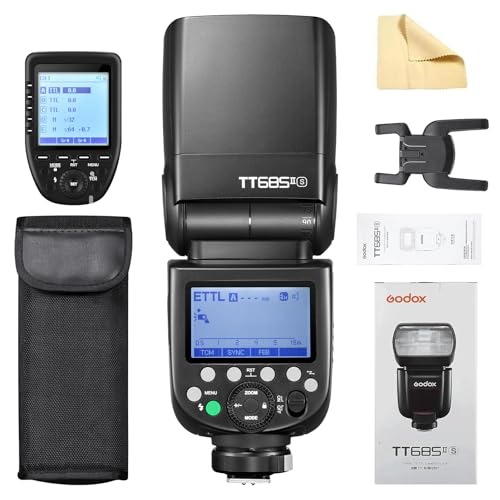
Godox TT685II-S Flash with Godox XPRO-S Wireless Flash Trigger Hot Shoe TTL GN60
Check today’s price →TTL for Sony with XPRO-S trigger bundled
View Today's Price
GODOX V1 V1-C V1C Godox Flash for Canon Flash Speedlite,76Ws 2.4G TTL1/8000 HSS
Round head design for soft, beautiful light quality
View Today's PriceHow to Choose the Right Camera Flashes
Choosing the right camera flash depends on your control preferences, power needs, camera compatibility, and real-world shooting style—trade-offs that interact in surprising ways. A feature that’s essential for event photographers can be pointless for studio shooters, and the wrong power source or guide number can ruin your workflow. Generic top-10 lists miss these nuances. Our recommendation engine evaluates your situation across five key dimensions and matches you to the ideal camera flash in under 60 seconds.
About this guide
Camera Flashes
Why Camera Flash Decisions Are Trickier Than They Look
Choosing camera flashes in 2026 is a balancing act with more variables than most photographers expect. The price gap among camera flashes is real: manual speedlights like the Neewer NW-565 cost just $50, but require you to set power by hand for every shot—great for control, but slow for fast-paced events. TTL camera flashes such as the Godox V860III, priced at $150–$200, automate exposure by reading your camera’s meter, saving time but adding cost and complexity. Head design in camera flashes matters: round-head camera flashes spin 360° for creative bounce, while standard heads only tilt, limiting your camera flashes for soft, indirect light. Wireless triggers add $30–$100 but let you place camera flashes anywhere, which is a significant upgrade for portraits and product work. Guide numbers (GN) in camera flashes are not just marketing fluff—GN36 is fine for small rooms, but you’ll need GN60 camera flashes to light subjects 30 feet away. Most buyers focus on price or brand and overlook these camera flash trade-offs, leading to mismatched camera flashes that either underperform or overcomplicate their workflow.
What Actually Separates Camera Flashes in 2026
The real differentiators in camera flashes go beyond the spec sheet. Power source is a make-or-break factor for camera flashes: lithium battery camera flashes like the Godox V860III deliver 600+ shots per charge and recycle in 1.5 seconds, while AA-powered camera flashes slow you down and burn through batteries after 200 shots. High-Speed Sync (HSS) is essential for outdoor portraits at 1/8000s, but it drains batteries three times faster—skip HSS on camera flashes unless you genuinely shoot wide open in bright sun. TTL is worth it for event shooters who need speed from their camera flashes, but if you always shoot manual, save the money. Wireless triggers, especially built-in 2.4G systems like Godox X, let you control multiple camera flashes off-camera and are now standard for serious setups. Brand compatibility in camera flashes is not optional: Canon’s RT system, Sony’s Mi interface, and Godox’s X-series all have quirks—get this wrong and you’ll lose TTL or HSS on your camera flashes. Don’t get distracted by zoom range or LCD size on camera flashes; focus on power, recycle time, and wireless reliability. Skip Profoto camera flashes unless you need absolute consistency and can justify the $800+ price tag.
How to Choose: Decision Factors That Matter Most
Your shooting style, camera system, and budget interact in ways that make choosing camera flashes surprisingly complex. Room size and subject distance dictate the guide number you need in camera flashes—GN60 for large venues, GN36 for tight spaces. Event and wedding photographers should prioritize fast recycle times and lithium batteries in camera flashes for 400+ shots per event, while studio shooters need wireless triggers and consistent color output from their camera flashes. Budget under $100 means manual-only camera flashes, likely AA-powered, while $150–$200 opens up TTL, lithium power, and HSS in camera flashes. Compatibility is non-negotiable: a camera flash built for Canon won’t deliver full features on Sony or Nikon. Our quiz evaluates your control preferences, wireless needs, power source, camera brand, and required output to match you to the right camera flashes. Don’t just chase the highest guide number or fanciest features in camera flashes—prioritize the specs that align with your real-world shooting. Remember, a feature that’s critical for one photographer is pointless for another, and overbuying camera flashes leads to wasted money and heavier gear.
Buyer's guide
How to choose
1Core Performance Criteria
- Prioritize a guide number of at least GN60 if you shoot large events or need to light subjects 30 feet away, as lower GN models struggle at distance.
- Lithium-ion battery flashes like the Godox V860III offer over 600 full-power shots and 1.5-second recycle times, far outpacing AA-powered alternatives for demanding shoots.
- High-Speed Sync is essential for outdoor portraits at fast shutter speeds, but drains battery three times faster—skip it unless you shoot wide open in bright light.
- TTL automation is a lifesaver for fast-paced events, but manual control gives you ultimate consistency and is better for controlled studio environments.
- Wireless triggering via built-in 2.4G systems enables multi-flash setups and creative off-camera lighting, which is now standard for advanced users.
- Brand-specific compatibility is crucial—Canon RT, Sony Mi, and Godox X-series all have unique protocols, and mismatches will limit flash features or reliability.
2Build Quality and Durability
- Premium flashes like the Profoto A1X and Godox V1 use reinforced hot shoes and robust plastics, reducing risk of breakage during frequent mounting and travel.
- Look for metal foot mounts and locking levers, as plastic mounts on budget models like the Neewer TT560 are prone to cracking after repeated use.
- Sealed battery compartments and weather-resistant gaskets are important if you shoot outdoor events or weddings in unpredictable conditions.
- Check for high-quality buttons and dials—stiff or mushy controls are a common complaint on sub-$80 speedlights and can slow down adjustments on the job.
- A durable hinge for the flash head is essential, especially for round-head models that rotate 360°; weak hinges develop wobble and sag over time.
- Warranty coverage matters: Godox and Yongnuo offer one-year warranties, but support quality varies—factor in repair options if you shoot professionally.
3Value Analysis
- Manual flashes like the Neewer NW-565 deliver unbeatable value at $50, but you sacrifice automation and speed—ideal for learning or backup use.
- Godox V860III and similar TTL models at $150–$200 offer the best feature-to-price ratio for most enthusiasts, with lithium power and wireless built-in.
- Paying $800+ for Profoto only makes sense if you demand absolute color consistency and fastest recycle times for commercial or studio work.
- Wireless triggers bundled with flashes save $30–$100 compared to buying separately, so look for kits if you plan off-camera setups.
- AA-powered flashes cost less upfront but require frequent battery purchases, raising long-term costs compared to lithium-powered models.
- Skip features like zoom head or LCD size unless you specifically need them—these rarely impact real-world value for most shooters.
4Use-Case Fit
- Wedding and event photographers need fast recycle times, lithium batteries, and TTL for rapid, reliable exposures over 400+ shots per event.
- Studio photographers benefit from wireless triggers and manual control, as consistent output and remote adjustment are more important than automation.
- Outdoor portrait shooters should prioritize High-Speed Sync and a high guide number to overpower sunlight and shoot at wide apertures.
- Travel photographers may prefer compact, AA-powered flashes for portability, but should accept slower recycle times and lower output.
- Product and macro shooters often need precise manual control and the ability to position flashes off-camera for creative lighting setups.
- If you only shoot indoors in small rooms, a GN36–GN40 flash is usually sufficient, and you can save money by skipping higher-output models.
5Common Mistakes to Avoid
- Don’t buy a TTL flash if you always shoot manual—save money and complexity by choosing a manual-only model like the Neewer TT560.
- Overlooking brand compatibility leads to lost features—Canon, Sony, and Nikon flashes are not fully interchangeable even with adapters.
- Ignoring recycle time can ruin event shoots—AA-powered flashes often lag behind lithium models, missing critical moments.
- Assuming higher guide number is always better—GN60 is overkill for small rooms and adds unnecessary weight and cost.
- Skipping wireless triggers limits creative lighting—built-in 2.4G systems are now essential for off-camera setups and multi-flash control.
- Neglecting battery costs adds up—AA batteries seem cheap but become expensive and inconvenient for high-volume shooters.
6Maintenance and Longevity
- Lithium battery flashes require proper charging cycles—avoid deep discharges and store partially charged to maximize lifespan over several years.
- Clean hot shoe contacts regularly to prevent misfires, especially if you frequently swap flashes between cameras or shoot in dusty environments.
- Replace AA batteries with fresh, high-quality cells before important shoots to avoid slow recycle times or sudden power loss.
- Inspect flash head hinges and locking mechanisms for wear—loose or wobbly heads are a sign of impending failure on older or budget models.
- Firmware updates can improve wireless reliability and compatibility—Godox and Yongnuo regularly release updates for their X-series and YN models.
- Store flashes in padded cases and avoid extreme temperatures, as heat and moisture degrade capacitors and battery performance over time.
FAQ
Frequently asked questions
Is TTL worth paying extra for in a camera flash?
TTL (Through The Lens) is absolutely worth the premium if you shoot events, weddings, or fast-paced situations where lighting changes constantly. TTL flashes like the Godox V860III automatically adjust output based on your camera’s metering, saving you time and missed shots. However, if you always shoot in manual mode or work in a controlled studio environment, you can safely skip TTL and save $100 or more. Manual flashes like the Neewer NW-565 are perfect for static setups and learning flash fundamentals.
How does Godox compare to Yongnuo and Neewer for wireless flash?
Godox leads in wireless reliability and cross-brand compatibility, thanks to its built-in 2.4G X-series system that works with Canon, Nikon, Sony, and Fujifilm. Yongnuo’s YN600EX-RT is solid for Canon RT users but less universal. Neewer offers budget-friendly wireless options, but their triggers can be less consistent and lack advanced features. For multi-flash setups or future expansion, Godox is the most flexible and robust choice in 2026.
What guide number do I need for indoor events versus outdoor portraits?
For indoor events in small to medium rooms, a guide number (GN) of 36 to 40 is usually sufficient. This output will light subjects up to 15–20 feet away. For outdoor portraits or large venues, you’ll want a GN60 flash to reach subjects at 30 feet or overpower sunlight. Remember, higher GN also means larger, heavier flashes—choose based on your most demanding scenario.
Are lithium battery flashes really better than AA-powered models?
Yes, lithium battery flashes like the Godox V860III or Profoto A1X are superior for high-volume shooting. They deliver over 600 full-power shots per charge and recycle in just 1.5 seconds. AA-powered flashes, such as the Neewer TT560, typically manage 200 shots before needing new batteries and recycle slower, which can cause missed shots during events. For professional or frequent use, lithium is worth the investment.
Do I need High-Speed Sync (HSS) for everyday photography?
High-Speed Sync is only necessary if you shoot outdoor portraits at wide apertures or need to freeze fast motion in bright light. HSS allows flash at shutter speeds up to 1/8000s, but it drains batteries much faster and is unnecessary for most indoor or studio work. If you rarely shoot outdoors or at high speeds, you can skip HSS and save money.
Which brands offer the best compatibility with Canon and Sony cameras?
For Canon, look for flashes supporting the RT wireless protocol, like the Yongnuo YN600EX-RT or Godox V860III-C. Sony users need Mi-compatible flashes, such as the Godox V860III-S. Godox’s X-series triggers are especially versatile, supporting Canon, Nikon, Sony, and Fujifilm with dedicated models. Always match the flash version to your camera brand for full TTL and HSS support.
Can I mix and match flashes from different brands in a wireless setup?
Mixing brands is possible, but you’ll lose advanced features like TTL and reliable wireless sync unless all flashes use the same trigger system. Godox X-series is the most universal, allowing you to control multiple flashes across brands with a single transmitter. Mixing Neewer, Yongnuo, and Godox may require separate triggers or manual-only operation, which complicates multi-light setups.
Related reading
Best Camera Flashes By Category
Related Guides
Action Cameras Buying Guide
Matched to your adventure style, budget, portability needs, and the features you’ll actually use—no more guessing.
Camera Drones
Matched to your footage style, portability, camera quality, and how long you want to fly per charge.
Advanced DSLR Cameras
Matched to your shooting style, sensor format, portability, video needs, and autofocus speed—get the right camera for your real workflow.
Beginner Drones
Matched to your flying style, risk tolerance, budget, and camera needs—get the right beginner drone for how you’ll actually fly.
Beginner Mirrorless Photography Cameras
Sensor size, stabilization, body style, and creative features—matched to your budget and how you actually want to shoot.