Skip the research trap. Get your portable camping fridges in 60 seconds.
We scored 300+ portable camping fridges across 5 dimensions — answer 5 quick questions and we'll match you to YOUR best pick.

Powered by DecisionScore™
Each product is evaluated across 18 weighted criteria — covering performance, value, build quality, and real-world usability. Your quiz answers re-weight the criteria to match what matters most to you, so two people can get different #1 picks from the same data.
See the DecisionScore methodology →- 32 quart (30L) compressor fridge/freezer
- Bluetooth APP control for remote temperature management
- -4°F to 68°F temperature range
Find your perfect portable camping fridges
5 quick questions. No quiz-takes-10-minutes trap. A personalized match from 28 scored picks — with clear reasoning for every recommendation.
What is the capacity of the fridge?
Capacity is crucial for determining how much food and drink you can store. Larger capacities are suitable for longer trips or larger groups, while smaller ones are more portable and energy-efficient.
- Day trips and overnights can use compact 20–25 quart fridges—no need to haul a 60-quart beast for a single night.
- Weekend trips (2–3 days) benefit from 30–40 quart capacity, especially if you want to avoid daily restocking.
- Weeklong or extended trips require 45+ quarts and dual-zone flexibility—plan for food, drinks, and frozen storage.
As an Amazon Associate and affiliate partner we earn from qualifying purchases. Links on this page may earn us a commission at no extra cost to you. Full disclosure
Not ready for the quiz? Here are our overall top picks
These are our top-rated picks overall. For a recommendation matched to YOUR specific needs,
BODEGACOOLER 12 Volt Car Refrigerator, Electric Cooler Portable Freezer APP
Check today’s price →32 quart (30L) compressor fridge/freezer
View Today's Price
BougeRV 12 Volt Car Refrigerator, CRD2 43 Quart Portable Fridge Freezer with APP
Check today’s price →43 quart dual-zone fridge and freezer
View Today's Price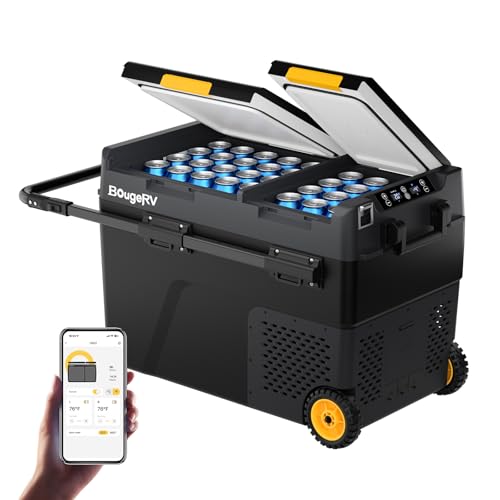
BougeRV 12 Volt Car Refrigerator, CRD2 52 Quart Portable Fridge Freezer with APP
Check today’s price →52 quart dual-zone fridge and freezer
View Today's PriceHow to Choose the Right Portable Camping Fridges
Choosing the right portable camping fridge depends on trip length, group size, power setup, and budget—trade-offs that shift based on your real-world camping style. A feature that’s perfect for solo overnighters can be a liability for weeklong family trips, and the wrong power compatibility could leave you stranded. Our recommendation engine evaluates your specific needs across five key dimensions and matches you to the best portable camping fridge in under 60 seconds.
About this guide
Portable Camping Fridges
Why Portable Camping Fridge Shopping Is Trickier Than It Looks
Choosing the right portable camping fridge in 2026 is a balancing act that trips up even seasoned campers. The main challenge with portable camping fridges? Navigating the trade-offs between compressor quality, capacity, power draw, and price. For instance, a $200 Alpicool C30 might seem like a steal among portable camping fridges, but it won’t match the efficiency or build quality of a $500 ICECO VL45 with a SECOP compressor. Many buyers focus only on quart size when comparing portable camping fridges, overlooking how dual-zone versus single-zone affects what you can store—dual-zone portable camping fridges let you keep ice cream frozen and drinks cold, but often cost $100–$200 more. Power compatibility is another stumbling block: some portable camping fridges run only on 12V DC, while others support AC outlets and solar, which is essential for off-grid trips. Most buyers underestimate weight—an empty 45-quart Dometic CFX5 portable camping fridge can top 40 lbs, making it tough to move when loaded. And don’t get fooled by flashy app controls on portable camping fridges; some are off by 1–2°F, which matters for food safety. The biggest mistake? Assuming all compressor portable camping fridges perform equally—cheap thermoelectric portable camping fridges simply can’t keep up in real-world heat.
What Actually Separates the Best Camping Fridges in 2026
The real differentiators among portable camping fridges are compressor quality, power efficiency, and zone flexibility. Skip thermoelectric portable camping fridges entirely—they can’t reliably hit freezer temps or handle summer heat. Compressor portable camping fridges with SECOP (Danfoss) units, found in ICECO and Setpower models, are the gold standard for energy efficiency and rapid cooling, easily dropping to -4°F even in 90°F weather. Dometic’s CFX3 series is the benchmark for serious overlanders: this portable camping fridge cools to 35°F in 15 minutes, draws under 50W, and offers robust app connectivity, but comes at a premium ($900+). For most, dual-zone portable camping fridges like the Bodega 59-quart or Dometic CFX5 75L are significant upgrades—simultaneous fridge and freezer zones prevent flavor transfer and let you pack both steaks and popsicles. App control is nice on portable camping fridges, but not all are accurate; always verify with a thermometer. Battery protection is non-negotiable if you don’t want to kill your starter battery while using portable camping fridges. Rugged builds with metal handles and removable baskets make a real difference for off-road use. Skip oversized portable camping fridges unless you’re feeding a crowd—weight and space add up fast.
How to Choose: Decision Factors and Real-World Interactions
Your ideal portable camping fridge depends on how trip length, group size, and power setup interact with your budget. For solo or couple weekenders, a 20–30 quart single-zone portable camping fridge like the Alpicool C30 is plenty, but families or weeklong trips demand 45+ quarts and dual-zone portable camping fridges. Off-grid adventurers need portable camping fridges with low power draw (<50W) and solar compatibility—think Dometic or ICECO portable camping fridges with ECO modes. If you’ll run portable camping fridges off a Jackery or Goal Zero power station, check how long a full charge will last (18+ hours is realistic for efficient portable camping fridges). Budget under $250 limits you to basic single-zone portable camping fridges, while $350–$600 opens up premium compressors, dual compartments, and rugged builds. The quiz evaluates your trip length, group size, zone preference, power sources, and budget to match you with the right portable camping fridge. Beyond that, consider how much weight you can realistically lift, whether you need removable baskets for cleaning, and if app control on portable camping fridges is worth the occasional 1–2°F inaccuracy. Don’t forget: a portable camping fridge that’s perfect for a solo overnighter is a headache for a family road trip.
Buyer's guide
How to choose
1Core Performance Criteria
- Prioritize compressor technology—SECOP (Danfoss) units in ICECO and Setpower models offer reliable -4°F cooling, outperforming cheaper thermoelectric fridges every time.
- Look for dual-zone capability if you want simultaneous fridge and freezer storage; single-zone is lighter and cheaper but far less flexible for mixed loads.
- Check average power draw—models like Dometic CFX5 45 run under 50W, allowing 18+ hours on a 1000Wh power station, crucial for off-grid use.
- Rapid cooldown matters: top models reach 32°F in 15–30 minutes, while budget units may take over an hour to stabilize at food-safe temps.
- Verify temperature range: premium fridges hit -7°F to 68°F, but some budget picks only reach 32°F, limiting their use for frozen goods or ice cream.
- App or Bluetooth controls are convenient but not always accurate—expect 1–2°F variance, so always double-check with a real thermometer for food safety.
2Build Quality and Durability
- Rugged construction is essential—look for reinforced corners, metal handles, and sturdy latches, especially if you’ll be bouncing down dirt roads or off-roading.
- Premium models like Dometic CFX3 and ICECO VL45 use thick insulation and durable plastics, which help retain cold and survive rough handling on long trips.
- Removable baskets and drain plugs make cleaning far easier, a feature missing from some budget models like older Alpicool units.
- Weight is a real factor: empty fridges can weigh 40+ lbs, and a loaded 75L model may require two people to move safely.
- Check the warranty—Dometic offers up to five years, while budget brands may only provide one year, reflecting their confidence in build quality.
- Inspect door hinges and seals; weak seals lead to cold loss and higher power use, while flimsy hinges often break after a season of heavy use.
3Value Analysis and Price Tiers
- Budget options under $250, like Alpicool C30, are ideal for short solo trips but lack advanced features and dual-zone flexibility.
- The $250–$400 range is the sweet spot: models like Bodega and Euhomy balance capacity, compressor quality, and app control without the Dometic markup.
- Mid-range ICECO and Setpower fridges use premium SECOP compressors at sub-$500 prices, offering efficiency close to flagship models for less.
- Premium fridges ($500–$600) justify their cost with dual zones, rugged builds, and advanced battery protection—ideal for frequent or extended overlanding.
- Beware of cheap thermoelectric fridges under $200; they can’t reliably freeze or keep food safe in hot weather, despite attractive price tags.
- Watch for seasonal deals—BougeRV and Euhomy often run 10–20% off, making mid-tier models more accessible for budget-conscious buyers.
4Use-Case Fit and Real-World Scenarios
- Solo campers and couples can get by with compact 20–30 qt fridges, but larger groups or longer trips need 45+ qt dual-zone models.
- For weeklong or family trips, prioritize capacity and dual-zone flexibility—Dometic CFX5 75L is designed for a week’s worth of meals for four.
- Off-grid or solar setups require fridges with low power draw and ECO modes; Dometic and ICECO are proven performers in this scenario.
- If you’re road-tripping in a sedan, measure trunk space before buying—a 45 qt fridge is bulky and heavy, especially when loaded.
- App control is handy for monitoring temps from the driver’s seat, but always verify with a thermometer if you’re storing raw meat or dairy.
- Choose models with battery protection if you plan to leave the fridge running overnight—this prevents draining your car’s starter battery.
5Common Mistakes and Pitfalls
- Many buyers underestimate fridge weight—an empty Dometic CFX5 45 is over 40 lbs, and a loaded 75L model can be nearly immovable solo.
- Assuming all compressor fridges are equal is a mistake—SECOP-equipped models cool faster and use less power than generic or thermoelectric units.
- Ignoring power compatibility leads to frustration; not all fridges support both 12V DC and 110V AC, limiting flexibility for home pre-chilling or backup.
- Skipping dual-zone for cost savings often backfires—single-zone models force you to choose fridge or freezer mode, never both at once.
- Overlooking battery protection risks stranding you with a dead starter—always choose models with adjustable low-voltage cutoffs for car camping.
- Neglecting to measure your vehicle’s cargo space can result in a fridge that won’t fit, especially with handles or open lids.
6Maintenance and Longevity
- Regularly clean interior baskets and drain plugs to prevent mold and lingering odors—removable baskets make this much easier, especially after long trips.
- Inspect door seals and hinges after every outing; cracked seals or loose hinges can lead to cold loss and compressor overwork.
- Run the fridge monthly, even off-season, to keep compressor lubricated and avoid seal dry-out—this prolongs lifespan, especially for premium units.
- Store fridges with lids slightly open to prevent mildew buildup, particularly in humid climates or after beach trips.
- Check power cords and connectors for wear; frayed cables are a common failure point and can cause intermittent power loss in the field.
- Register your warranty immediately—brands like Dometic and ICECO offer multi-year coverage, but only if you register within 30 days of purchase.
FAQ
Frequently asked questions
Is dual-zone worth paying extra for in a portable camping fridge?
Dual-zone fridges are absolutely worth the investment if you want to keep both frozen and chilled items on the same trip. For example, the Bodega 59-quart and Dometic CFX5 75L let you store ice cream and fresh veggies simultaneously—no flavor mixing. While dual-zone models typically cost $100–$200 more than single-zone, the flexibility and convenience pay off for families or longer adventures. If you only ever need to chill drinks or basic groceries, a single-zone fridge can save you money and weight.
How does Dometic compare to Alpicool for camping fridges in 2026?
Dometic fridges, like the CFX5 series, are the gold standard for efficiency, insulation, and rapid cooling, but they’re much pricier—often $900–$1400. Alpicool models, such as the C30, offer reliable cooling and great value for $200–$250, but lack the advanced features, build quality, and warranty of Dometic. For heavy use, overlanding, or off-grid trips, Dometic’s low power draw and five-year warranty justify the investment. For short, casual trips, Alpicool is a smart budget pick.
What capacity do I need for a weeklong family camping trip?
For a weeklong camping trip with a family of four, look for a fridge with at least 60–75 quarts (or liters) of capacity, ideally with dual-zone compartments. Models like the Dometic CFX5 75L or Bodega 59-quart are designed to hold a week’s worth of meals and drinks. Anything under 45 quarts will require daily restocking or creative packing. Remember, larger fridges are heavy—expect 60–80 lbs when loaded, so plan your vehicle space and lifting help accordingly.
Are app-controlled portable fridges reliable for temperature accuracy?
App-controlled fridges are convenient for monitoring and adjusting temperatures remotely, but most apps are 1–2°F off compared to actual internal temps. This is fine for most uses, but if you’re storing raw meat or dairy, always verify with a physical thermometer. Dometic and Bodega apps are user-friendly but not perfect. Don’t rely solely on the app for food safety—use it for convenience, not as your only check.
Can I run a portable fridge off a solar generator or power station?
Yes, most modern compressor fridges—especially those from Dometic, ICECO, and Setpower—are designed for low power draw and work well with solar generators or portable power stations. Look for models that average under 50W, like the Dometic CFX5 45, to get 18+ hours of runtime from a 1000Wh station. ECO modes further extend battery life. Always check your generator’s output and the fridge’s surge requirements before heading off-grid.
What’s the difference between compressor and thermoelectric camping fridges?
Compressor fridges, found in brands like Dometic, ICECO, and Alpicool, use a real refrigerant system to reach freezer temps as low as -7°F, even in hot weather. Thermoelectric fridges are cheaper but can’t cool below 40°F below ambient temperature—useless for freezing or safe meat storage in summer. Always choose a compressor fridge for camping, especially if you need reliable cooling on long trips or in extreme heat.
How heavy are portable camping fridges, and does weight matter?
Weight is a major consideration—an empty 45-quart Dometic CFX5 weighs over 40 lbs, and a fully loaded 75L model can exceed 80 lbs. Budget models like Alpicool are lighter but still substantial when filled. If you’ll be moving your fridge in and out of a vehicle frequently, check both empty and loaded weights. For solo travelers, stick to 20–30 quart models; larger fridges often require two people to lift safely.
Related reading
Best Portable Camping Fridges By Category
Related Guides
Advanced Telescopes
Aperture, mount type, portability, and setup—matched to your observing goals and real-life constraints in seconds.
Avalanche Beacons & Transceivers
Skill level, rescue needs, budget, battery type, and Bluetooth—get matched to the safest avalanche beacon for your backcountry trips.
Backyard Playground Sets
Play features, yard size, age range, and installation—get matched to a backyard playground set that truly fits your family.
Backyard Trampolines
We match trampolines to your jumpers’ ages, bounce style, yard size, safety needs, and budget—no more guessing or risky shortcuts.
Bike Lights
Matched to your commute, riding environment, brightness needs, charging style, and budget—get the right bike light for your safety.