Skip the research trap. Get your mini fridges in 60 seconds.
We scored 350+ mini fridges across 5 dimensions — answer 5 quick questions and we'll match you to YOUR best pick.

Powered by DecisionScore™
Each product is evaluated across 18 weighted criteria — covering performance, value, build quality, and real-world usability. Your quiz answers re-weight the criteria to match what matters most to you, so two people can get different #1 picks from the same data.
See the DecisionScore methodology →- 2.6 cu ft compact fridge with freezer and 8-can dispenser built in
- Two frameless slide-out shelves for easy organization
- 2-liter door storage for tall bottles
Find your perfect mini fridges
5 quick questions. No quiz-takes-10-minutes trap. A personalized match from 34 scored picks — with clear reasoning for every recommendation.
Where will you primarily use your mini fridge?
Dorm rooms and offices often need quieter, more compact units. Garages and game rooms can accommodate larger or noisier models.
- Dorm rooms and bedrooms need quieter fridges—look for 42 dB or less to avoid sleep disruption.
- Home offices benefit from sleek, stainless designs that blend in and are easy to clean.
- Game rooms or bars can handle bolder, retro styles and don’t require ultra-quiet operation.
As an Amazon Associate and affiliate partner we earn from qualifying purchases. Links on this page may earn us a commission at no extra cost to you. Full disclosure
Not ready for the quiz? Here are our overall top picks
These are our top-rated picks overall. For a recommendation matched to YOUR specific needs,
Igloo 2.6 Cu.Ft Mini Fridge with Freezer- Single Door Compact Refrigerator with
2.6 cu ft compact fridge with freezer and 8-can dispenser built in
View Today's Price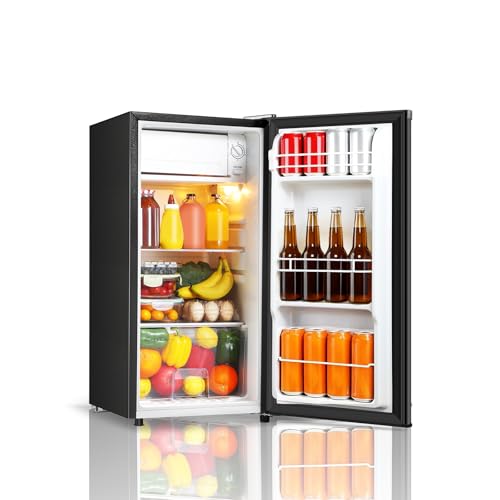
Seaoola Mini Fridge with Freezer, Single Door 3.1 Cu.Ft, Compact Mini
2.4 cu ft under-counter fridge with small freezer compartment
View Today's Price
COSTWAY Compact Refrigerator, Single Door 3.2 CU.FT. Mini Fridge Compartment
3.2 cu ft single-door compact fridge with freezer compartment
View Today's PriceHow to Choose the Right Mini Fridges
Choosing the right mini fridge depends on how storage capacity, cooling technology, noise level, style, and budget interact—trade-offs that shift based on your space, usage, and aesthetic preferences. A feature that’s perfect for a dorm room might be all wrong for a home office or apartment kitchen. Our recommendation engine evaluates your specific needs across five key dimensions and matches you to the right mini fridge in under 60 seconds.
About this guide
Mini Fridges
Why Mini Fridge Shopping Is Trickier Than It Looks
Choosing mini fridges in 2026 is a balancing act between size, cooling power, noise, and style. Most buyers underestimate how much real storage mini fridges actually provide—1.7 cubic feet is barely enough for drinks and snacks, while 3.1–3.3 cu ft mini fridges can handle a week’s groceries for one person. Compressor-based mini fridges are non-negotiable if you want food safety; thermoelectric mini fridges often fail to keep items below 40°F, especially in warm rooms, leading to spoiled leftovers or unsafe medication storage. Price tiers matter: $100–$149 gets you basic single-door mini fridges, but you’ll sacrifice freezer performance and energy efficiency. Step up to $150–$200 for dual-door mini fridges like the Midea WHD-113FB1 or Galanz GLR31TBEER, which offer true freezer compartments and better temperature consistency. Premium $200–$300 mini fridges add Energy Star ratings, retro styling, and quieter operation—essential for bedrooms or home offices. What most buyers get wrong? They assume all mini fridges are real refrigerators, but many mini fridges are just beverage coolers that can’t keep food safe. Always check the specs on mini fridges and test with a thermometer if in doubt.
What Actually Sets Mini Fridges Apart in 2026
Not all mini fridges are created equal—real differences go far beyond color or brand. Compressor-based mini fridges from Midea, Danby, and EUHOMY deliver reliable cooling, while thermoelectric mini fridges (often under $130) are best skipped unless you only need to chill drinks. Dual-door mini fridges with separate freezer compartments, like those from Galanz and COSTWAY, are significant upgrades if you want to store frozen food or make ice. Don’t be fooled by “freezer” labels on single-door mini fridges; most can’t hold 0°F for safe meat storage. Noise matters more than you’d think: only mini fridges rated at or below 42 dB are truly quiet enough for bedrooms or shared offices. Energy Star certification on mini fridges isn’t just a sticker—it can save real money over years of continuous use. Retro mini fridges from Frigidaire and Upstreman add flair but often cost more for the same capacity. Skip app-controlled portable mini fridges unless you need car/van use; traditional dorm and apartment mini fridges are more reliable and offer better value for most buyers. Prioritize compressor tech, true dual-door layout, and measured noise levels in mini fridges over flashy extras.
How to Choose: Decision Factors That Interact
Your ideal mini fridge depends on where it’ll live, how much you need to store, and your noise tolerance. Room size and placement dictate which mini fridges will fit: a dorm or office might only accommodate a 1.7–2.0 cu ft mini fridge, but small apartments can handle 3.1–3.3 cu ft mini fridges. If you need a freezer, only dual-door mini fridges like the Midea WHD-113FB1 or Galanz GLR31TBEER will keep ice cream solid—single-door mini fridges just don’t cut it. Budget is a hard constraint: under $150 means basic mini fridges, while $200+ unlocks Energy Star efficiency and quieter operation. Design is more than looks; retro mini fridges take up more space and may lack adjustable shelving. Our quiz weighs your location, storage needs, freezer preference, style, and budget in one go. Beyond that, think about maintenance—Energy Star mini fridges cost less to run, but may be pricier up front. Don’t forget to measure your space, check door swing clearance, and consider reversible doors for tight installs. The right mini fridge is the one that fits your real-world routine, not just your Pinterest board.
Buyer's guide
How to choose
1Core Performance Criteria
- Compressor-based cooling is essential for food safety—thermoelectric models often fail to keep food below 40°F, especially in warm rooms.
- Dual-door mini fridges with separate freezer compartments, like the Midea WHD-113FB1, reliably reach 0°F for safe frozen food storage.
- Noise level is crucial for bedrooms or offices—look for models rated at 42 dB or below to avoid sleep or work disruptions.
- Energy Star certification isn’t just a label; these models use less power and reduce long-term electricity costs, especially for 24/7 operation.
- Capacity matters: 1.7–2.0 cu ft fits snacks and drinks, while 3.1–3.3 cu ft handles groceries for one person or a small group.
- Check for adjustable thermostats and interior lighting—these features improve usability and help you monitor temperature for food safety.
2Build Quality and Durability
- Look for sturdy hinges and reversible doors—Midea and Danby models are known for robust construction that holds up to daily use.
- Glass shelves are easier to clean and more durable than wire racks, especially for heavier items or frequent rearrangement.
- Models with stainless steel or premium finishes, like EUHOMY or Danby, resist dents and scratches better than basic painted steel.
- Retro-styled fridges from Galanz or Frigidaire use thicker plastics and chrome accents, but may be heavier and harder to move.
- Check for a well-sealed gasket on the door—poor seals cause frost buildup and reduce cooling efficiency over time.
- Removable crisper drawers and baskets are a plus for cleaning and adapting the fridge to different storage needs.
3Value Analysis and Price Tiers
- Budget mini fridges under $150 are usually single-door, lack true freezers, and may use less reliable thermoelectric cooling.
- The $150–$200 range is the sweet spot—expect dual-door designs, compressor cooling, and better build quality from brands like Midea and Galanz.
- Premium models ($200–$300) add Energy Star ratings, quieter operation, and stylish finishes, but don’t always offer more storage.
- Avoid sub-$120 units unless you only need beverage cooling; these often struggle to maintain safe food temperatures.
- Retro designs and bold colors add $30–$50 to the price without improving performance—pay for looks only if it matters to you.
- Watch for seasonal sales—back-to-school and holiday promotions can drop prices on top models by $30–$60.
4Use-Case Fit and Real-World Scenarios
- Dorm rooms and bedrooms need quiet, compact models—42 dB or lower is a must for undisturbed sleep or study.
- Home offices benefit from stainless steel or black finishes for a professional look and easy cleaning.
- Game rooms and bars are perfect for retro-styled fridges from Frigidaire or Galanz, adding personality and color.
- If you store frozen meals or ice cream, prioritize dual-door units with a true freezer compartment—single-door chillers won’t keep items frozen.
- Small apartments can fit larger 3.1–3.3 cu ft models, but always measure your space and check door swing clearance.
- Portable, app-controlled fridges are best for car or RV use, but offer less value for stationary home or dorm setups.
5Common Mistakes and Pitfalls
- Assuming all mini fridges are real refrigerators—many are just beverage coolers and can’t safely store perishable food.
- Overestimating capacity: 1.7 cu ft fills up fast, especially with drinks or meal prep containers.
- Ignoring noise ratings—anything over 45 dB can be disruptive in quiet spaces like bedrooms or offices.
- Buying based on looks alone—retro models may lack adjustable shelves or true freezer sections.
- Skipping Energy Star models to save upfront—non-certified fridges cost more in electricity over time.
- Not checking for reversible doors or adjustable feet, which are essential for fitting tight or awkward spaces.
6Maintenance and Longevity
- Compressor-based fridges last 5–8 years on average; thermoelectric models often fail within 2–3 years of daily use.
- Manual defrosting is required for most mini fridges—plan to defrost the freezer every 2–3 months for peak efficiency.
- Clean door gaskets regularly to prevent mold and maintain a tight seal, especially if storing sticky drinks or snacks.
- Energy Star models tend to run cooler and drier, reducing internal condensation and extending component life.
- Removable shelves and drawers make cleaning spills and crumbs much easier, reducing odor and bacteria buildup.
- Check warranty terms—Midea, Danby, and Galanz typically offer 1-year coverage, but extended warranties may be available on premium models.
FAQ
Frequently asked questions
Is a compressor-based mini fridge worth the extra cost over thermoelectric models?
Absolutely—compressor-based mini fridges are the only reliable choice for food safety in 2026. They consistently maintain temperatures below 40°F, even in warm rooms or during summer. Thermoelectric models may be cheaper (often under $130), but they struggle to keep food safe and are best reserved for chilling beverages. If you plan to store leftovers, dairy, or medication, spend the extra $30–$60 for a compressor-based unit from brands like Midea or Danby. The peace of mind and food safety easily justify the price difference.
How does Midea compare to Galanz for mini fridges?
Midea and Galanz both offer strong mini fridges in 2026, but they serve slightly different needs. Midea’s dual-door models (like the WHD-113FB1) are known for quiet operation, reliable compressor cooling, and practical features like reversible doors and glass shelves. Galanz stands out for retro styling and bold colors, making them a favorite for game rooms or dorms. Both deliver solid performance, but choose Midea for understated, efficient designs and Galanz if you want your fridge to double as decor.
What capacity mini fridge do I need for a dorm room or office?
For most dorm rooms or office setups, a 1.7–2.0 cu ft mini fridge is sufficient for drinks, snacks, and a few meal prep containers. If you plan to store a week’s worth of groceries or want a true freezer, step up to a 3.1–3.3 cu ft model. Dual-door designs like the Midea WHD-113FB1 or Galanz GLR31TBEER maximize usable space and make it easier to separate frozen and fresh items. Always measure your available space before buying—larger units may not fit under desks or in tight corners.
Are retro mini fridges from Frigidaire or Upstreman just for looks?
While retro mini fridges from Frigidaire and Upstreman are known for their colorful, vintage-inspired designs, they also offer solid performance. Most use compressor-based cooling and include dual-door layouts, making them practical as well as stylish. However, you’ll typically pay $30–$50 more for the retro aesthetic compared to a similarly sized modern unit. Choose these models if you want your fridge to be a statement piece in a game room, dorm, or home bar, but don’t expect extra features beyond the looks.
How loud are mini fridges, and does it matter for bedrooms?
Noise is a make-or-break factor for bedroom or office use. Look for mini fridges rated at 42 dB or below—these are quiet enough to avoid disturbing sleep or concentration. Many dual-door models from Midea and Danby meet this threshold. Avoid units over 45 dB, as the compressor cycling can be surprisingly disruptive in quiet environments. If you’re especially sensitive to noise, check user reviews for real-world feedback, since some models run louder than their specs suggest.
What’s the difference between a mini fridge and a beverage cooler?
A true mini fridge uses compressor-based cooling and can reliably keep food below 40°F, making it safe for leftovers, dairy, and medication. Beverage coolers, often labeled as mini fridges in hotels or budget listings, may only chill to 45°F or higher—dangerous for perishable food. Always check the technical specs and look for a stated temperature range. If in doubt, test your fridge with a thermometer after setup. For anything beyond drinks, only trust a real mini fridge.
How do EUHOMY and Danby mini fridges compare for small apartments?
EUHOMY and Danby both offer reliable mini fridges for small apartments in 2026. Danby models are praised for their sturdy build, stainless finishes, and quiet operation—ideal for kitchens or open-plan spaces. EUHOMY often delivers slightly more capacity for the price and includes features like adjustable glass shelves and reversible doors. Both brands offer Energy Star models and dual-door layouts, but Danby edges ahead in long-term durability. Choose based on your size needs, finish preference, and available space.
Best Mini Fridges By Category
Related Guides
Bidet Toilets & Bidet Seats
Matched to your bathroom wiring, toilet shape, budget, and which features you’ll actually use—get a bidet seat that really fits your life.
Compact Tankless Water Heaters
Fuel type, flow rate, installation, and smart features—matched to your home, climate, and real hot water needs.
Compact Ventless Dryers
Matched to your space, power supply, laundry habits, and the features you’ll actually use—no more guessing or wasted cycles.
Greywater Recycling Systems
Matched to your water source, reuse plans, property type, and budget—get the right greywater system for your home or RV.
Heat Pump Water Heaters
Capacity, efficiency, install space, and smart features—get matched to the right heat pump water heater for your home and budget.