Skip the research trap. Get your sim racing wheels in 60 seconds.
We scored 300+ sim racing wheels across 5 dimensions — answer 5 quick questions and we'll match you to YOUR best pick.

Powered by DecisionScore™
Each product is evaluated across 18 weighted criteria — covering performance, value, build quality, and real-world usability. Your quiz answers re-weight the criteria to match what matters most to you, so two people can get different #1 picks from the same data.
See the DecisionScore methodology →- Direct drive motor with 21.0 Nm torque for lifelike force feedback
- Compatible with PC platforms
- Pedals not included; pair with your preferred set
Find your perfect sim racing wheels
5 quick questions. No quiz-takes-10-minutes trap. A personalized match from 30 scored picks — with clear reasoning for every recommendation.
What type of force feedback system do you prefer?
Force feedback systems vary in realism and responsiveness. Direct drive systems offer the most realistic experience, while belt and gear systems are more common and affordable.
- Direct drive offers the most detailed, lifelike force feedback but costs more and requires a stable rig.
- Belt drive systems are quieter and smoother than gear drive, and strike a good balance for most users.
- Gear drive wheels are affordable and often bundled with pedals, but lack the realism of direct or belt systems.
As an Amazon Associate and affiliate partner we earn from qualifying purchases. Links on this page may earn us a commission at no extra cost to you. Full disclosure
Not ready for the quiz? Here are our overall top picks
These are our top-rated picks overall. For a recommendation matched to YOUR specific needs,
MOZA R12 V2 Direct Drive Sim Racing Wheelbase 12Nm Force Feedback Base
Direct drive motor with 21.0 Nm torque for lifelike force feedback
View Today's Price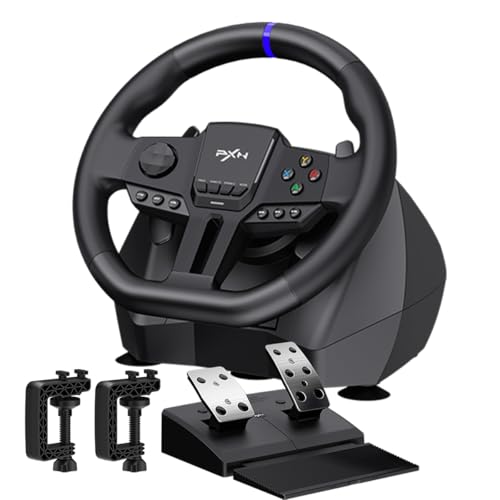
PXN Gaming Steering Wheel - 270/900° V900 GEN2 Sim Racing Wheel
Direct drive motor with 6.0 Nm torque for lifelike force feedback
View Today's Price
PXN V10 Ultra Direct Drive Racing Wheel, 3.2Nm Force Feedback
Direct drive motor with 3.2 Nm torque for lifelike force feedback
View Today's PriceHow to Choose the Right Sim Racing Wheels
Choosing the right high end sim racing wheel depends on force feedback system, platform compatibility, pedal needs, and your realism expectations—trade-offs that shift based on your setup and racing style. A feature that’s perfect for a dedicated cockpit can be totally wrong for a casual desktop user or console gamer. Our recommendation engine evaluates your specific requirements across 15+ dimensions and matches you to the right sim racing wheel in under 60 seconds.
About this guide
Sim Racing Wheels
Why Sim Racing Wheel Decisions Are So Complex in 2026
Picking high end sim racing wheels in 2026 is a minefield of trade-offs that most buyers underestimate. When shopping for high end sim racing wheels, you’re choosing between $400 belt-driven bundles and $2,000+ direct-drive units pushing 25Nm of torque, with each step up affecting realism, compatibility, and cost. Many shoppers focus on headline specs like torque or wheel rotation, but overlook how the drive system type (direct drive, belt, or gear) in high end sim racing wheels fundamentally changes the feel and longevity of the wheel. For example, Fanatec, Thrustmaster, and Moza direct-drive high end sim racing wheels offer 8-25Nm torque and unmatched realism, but require a sturdy rig and add hundreds to your setup cost. Belt-driven high end sim racing wheels at $300-$800, like the Thrustmaster T248, strike a balance between price and performance, while gear-driven high end sim racing wheels bundle pedals cheaply but can’t deliver the smooth force feedback serious racers demand. It’s easy to get lured by flashy features or bundled accessories in high end sim racing wheels, but most buyers get tripped up by platform compatibility and mounting requirements. Ignore these, and you risk ending up with high end sim racing wheels that won’t even work with your console or feel unstable during intense sessions.
What Actually Differentiates Sim Racing Wheels: The Specs and Features That Matter
The real differences between high end sim racing wheels come down to force feedback system, platform support, and build quality—not just brand or price. Direct-drive high end sim racing wheels from Fanatec, Moza, and Thrustmaster deliver the strongest, most nuanced feedback (8-25Nm), but only make sense if you want uncompromising realism and have a cockpit or heavy-duty mount for your high end sim racing wheels. For most, mid-range belt-driven high end sim racing wheels like the Thrustmaster T248 or Logitech G923 (both $300-$350) hit the sweet spot, offering 900-degree rotation and strong feedback that works well for both casual and competitive play. Skip gear-driven high end sim racing wheels unless your budget is tight and you value bundled pedals over feedback quality. Platform compatibility is non-negotiable: some high end sim racing wheels only work on PC, while others like the T248 and G923 support PS5, Xbox, and PC out of the box. Quick-release hubs, OLED displays, and load-cell brake pedals add $100-$500 to high end sim racing wheels but only matter if you’re chasing pro-level immersion. Don’t overpay for wireless—wired high end sim racing wheels are faster and more reliable, especially for competitive sim racing. Prioritize torque and mounting stability in high end sim racing wheels over flashy extras.
How to Choose: Decision Factors and Interactions That Shape Your Perfect Match
Your ideal high end sim racing wheels are defined by how your platform, budget, and realism goals interact—not by chasing the highest spec. For example, if you’re on Xbox, you must check for verified compatibility; many high end sim racing wheels are PC-only or PlayStation-focused. PC users get more high end sim racing wheels options but need to match wheel torque to their rig’s mounting strength—25Nm direct-drive high end sim racing wheels are useless if your desk wobbles. Racing style matters: F1 fans may want a formula rim on their high end sim racing wheels, while GT or rally drivers prefer round or larger wheels. Pedal sets are another key variable; some high end sim racing wheels bundles save money but compromise on pedal quality, while others let you pair a premium load-cell set for better braking feel. Our quiz evaluates your force feedback preference, platform, pedal needs, brand loyalty, and realism expectations to pinpoint the best high end sim racing wheels fit. Beyond that, consider your space, how often you’ll upgrade your high end sim racing wheels, and whether you want future-proof features like quick-release hubs or modular pedals. Don’t let a single spec or review sway you—think about how all these high end sim racing wheels factors combine in your setup.
Buyer's guide
How to choose
1Core Performance Criteria
- Direct-drive wheels deliver 8-25Nm torque for the most realistic force feedback, but require a sturdy cockpit or rig to handle the power.
- Belt-driven models like the Thrustmaster T248 and Logitech G923 offer 7-9Nm torque and 900-degree rotation, balancing immersion and affordability.
- Gear-driven wheels bundle pedals affordably but lack the smooth, detailed feedback needed for serious sim racing enthusiasts.
- Look for at least 900-degree rotation for versatility across F1, GT, and rally games—lower rotation limits realism in advanced sims.
- Strong force feedback is crucial for immersion; weak feedback (common in PXN or entry-level HORI) makes sim-heavy games feel lifeless.
- Quick-release hubs and load-cell brake pedals add realism and control, but typically increase the price by $100-$500 depending on the model.
2Build Quality and Durability
- Fanatec, Thrustmaster, and Moza direct-drive wheels use robust metal housings that withstand years of heavy racing sessions without flex.
- Mid-range wheels like the Logitech G923 and Thrustmaster T248 feature reinforced plastics and solid mounting points for reliable daily use.
- Entry-level wheels (e.g., PXN, HORI) often suffer from loose quick-release mechanisms or weak desk clamps, risking detachment mid-race.
- Check for pedal sets with metal construction and load-cell sensors, as plastic pedals with potentiometers wear out faster under hard braking.
- Wheels with modular rims and swappable components tend to last longer, since you can replace worn parts without buying a whole new system.
- Warranty coverage from major brands like Thrustmaster and Logitech is typically two years, but always confirm before purchase for peace of mind.
3Value and Price Analysis
- The $200-$400 range is the value sweet spot in 2026, with models like the Thrustmaster T248 and Nacon Revosim delivering strong feedback and broad compatibility.
- Direct-drive wheels above $1,000 offer elite realism, but diminishing returns for casual racers who don’t use a dedicated cockpit.
- Budget wheels under $200, such as PXN or entry-level HORI, compromise on feedback, build quality, and platform support—best for occasional arcade use only.
- Nacon Revosim stands out for 9Nm torque at $250, beating pricier rivals in torque-per-dollar for newcomers wanting premium feel affordably.
- Accessories like quick-release hubs, OLED displays, and load-cell pedals add $100-$500 to the total cost, so factor these into your budget.
- Bundles with pedal sets can save money, but always compare pedal quality—some bundled sets use basic potentiometers instead of more durable load-cell sensors.
4Use-Case Fit and Platform Compatibility
- Always verify platform support: some wheels are PC-only, while others like Thrustmaster T248 and Logitech G923 support PS5, Xbox, and PC seamlessly.
- Formula-style rims are ideal for F1 and GT games, while round wheels suit rally and touring car sims for better comfort and realism.
- If you race on a desk, prioritize models with stable clamps—lap rests (e.g., Turtle Beach Racer) feel unstable in intense sim sessions.
- Console racers should avoid PC-only wheels; Xbox users especially must check for PlayStation-incompatible models like the Thrustmaster TMX/TX.
- PC users have more wheel options but must ensure their rig can handle the torque of direct-drive units, especially above 10Nm.
- Pedal preferences matter: some wheels include basic pedals, while others allow for premium upgrades—choose based on your braking style and future plans.
5Common Mistakes and Pitfalls
- Many buyers overlook platform compatibility, ending up with a wheel that won’t work on their console or lacks in-game preset support.
- Prioritizing wheel rotation over torque is a common mistake—9Nm torque (Nacon) delivers more realism than 900-degree rotation alone.
- Desk-mounted wheels with weak clamps or lap rests (e.g., Turtle Beach Racer) can detach or wobble during aggressive racing sessions.
- Cheap quick-release mechanisms (often found in PXN or entry-level wheels) can loosen mid-race, breaking immersion and risking hardware damage.
- Arcade-focused wheels like HORI lack the detailed force feedback and preset support needed for advanced sim racing titles.
- Ignoring pedal quality leads to frustration—plastic pedals with basic sensors wear out quickly and lack the nuanced control of load-cell options.
6Maintenance and Longevity
- Direct-drive wheels require periodic inspection of mounting bolts and electronics, especially if used at high torque settings for extended sessions.
- Belt-driven models need occasional belt tension checks and cleaning to maintain smooth, quiet operation over years of use.
- Keep quick-release hubs and connectors clean and lubricated to prevent wear and ensure tight, reliable attachment during races.
- Pedal sets with load-cell sensors last longer and maintain accuracy better than potentiometer-based pedals, which can develop dead zones over time.
- Store wheels and pedals in a dry, dust-free environment to prevent premature wear of electronic components and moving parts.
- Firmware updates from brands like Thrustmaster and Logitech can improve compatibility and performance—check for updates every few months to keep your wheel at its best.
FAQ
Frequently asked questions
Is direct-drive worth the extra cost over belt or gear-driven wheels?
Direct-drive sim racing wheels absolutely deliver the most realistic feedback, with torque levels up to 25Nm and ultra-fast response. However, they’re only worth the $1,000+ investment if you have a sturdy cockpit and want pro-level immersion. For most users, mid-range belt-driven wheels like the Thrustmaster T248 or Logitech G923 provide 80% of the realism at a fraction of the price. Unless you’re a competitive sim racer or want maximum detail, a high-quality belt-driven wheel is the smarter value.
How does the Thrustmaster T248 compare to the Logitech G923?
The Thrustmaster T248 and Logitech G923 are both top picks in the $300-$350 range, but differ in feel and compatibility. The T248 offers stronger force feedback and 900-degree rotation, making it better for immersion in F1 and GT games. The G923 excels in plug-and-play ease, with reliable presets for major sims and broad platform support. If you want maximum realism and don’t mind a learning curve, go T248. For simplicity and wide game compatibility, the G923 is hard to beat.
What torque rating do I need for a realistic sim racing experience?
For a realistic sim racing experience, look for wheels with at least 7-9Nm of torque. Models like the Thrustmaster T248 and Nacon Revosim hit this sweet spot, delivering strong, detailed feedback without overwhelming casual users. Direct-drive wheels with 15Nm or more are best for competitive drivers or those with dedicated cockpits. Anything below 5Nm, as found in budget PXN or HORI wheels, feels weak and fails to capture the nuances of advanced sim titles.
Are bundled pedal sets good enough, or should I upgrade?
Bundled pedal sets vary widely in quality. Entry-level bundles often use plastic pedals with basic potentiometer sensors, which wear out quickly and lack braking nuance. Mid-range wheels like the Thrustmaster T248 include decent pedals, but upgrading to a load-cell set can dramatically improve realism and control. If you’re serious about sim racing, invest in a quality pedal set—especially for competitive play or advanced sims where precise braking makes a difference.
Which brands offer the best long-term reliability in 2026?
In 2026, Thrustmaster and Logitech remain the most reliable brands for sim racing wheels, thanks to robust build quality, strong warranty support, and frequent firmware updates. Fanatec and Moza lead in the direct-drive segment, but require more maintenance and have higher upfront costs. Avoid ultra-budget brands like PXN or entry-level HORI if you want a wheel that lasts several years of regular use. Always check for solid mounting hardware and proven pedal durability.
How important is platform compatibility for sim racing wheels?
Platform compatibility is critical—many buyers regret skipping this step. Some wheels are PC-only, while others like the Thrustmaster T248 and Logitech G923 support PS5, Xbox, and PC. Xbox users must avoid PlayStation-only models like the Thrustmaster TMX/TX. Always confirm compatibility with your console or PC and check for in-game preset support to avoid frustration. Multi-platform wheels offer the most flexibility if you switch systems or share with others.
What features should I prioritize for competitive sim racing?
For competitive sim racing, prioritize strong force feedback (at least 9Nm torque), a quick-release hub for wheel swaps, and a load-cell brake pedal for precise braking. Direct-drive wheels from Fanatec or Moza are ideal if you have a cockpit. Look for wired connections to minimize input lag, and ensure your rig can handle the torque. Skip wireless and entry-level pedals—they can cost you valuable milliseconds in tight races.
Best Sim Racing Wheels By Category
Related Guides
Controller Lanyards
Device compatibility, attachment style, comfort, and value—get matched to the right lanyard for your controller and gaming habits.
Enthusiast Mechanical Keyboards
Matched to your layout, switch feel, wireless needs, modding plans, and budget—get the perfect enthusiast keyboard for your workflow.
Esports Gaming Mice Bundles
Matched to your genre, budget, keyboard size, connection, and mousepad needs—get the right esports bundle for your setup.
Gaming Keyboards
Switch feel, layout, RGB, and budget—get matched to the perfect gaming keyboard for your setup and play style.
Gaming Routers
Wi-Fi standard, home size, device load, and gaming platform—all matched to your budget for the perfect gaming router.