Skip the research trap. Get your enthusiast mechanical keyboards in 60 seconds.
We scored 350+ enthusiast mechanical keyboards across 5 dimensions — answer 5 quick questions and we'll match you to YOUR best pick.

Powered by DecisionScore™
Each product is evaluated across 18 weighted criteria — covering performance, value, build quality, and real-world usability. Your quiz answers re-weight the criteria to match what matters most to you, so two people can get different #1 picks from the same data.
See the DecisionScore methodology →- TKL 87-key layout in Tokyo cherry-blossom colorway
- Dye-sublimation thick PBT keycaps for decades of wear resistance
- N-Key Rollover for conflict-free simultaneous key presses
Find your perfect enthusiast mechanical keyboards
5 quick questions. No quiz-takes-10-minutes trap. A personalized match from 31 scored picks — with clear reasoning for every recommendation.
What type of connectivity do you prefer?
Connectivity options determine how your keyboard communicates with your computer. Wireless options offer more flexibility and less cable clutter, while wired connections can provide more stability and lower latency, which is crucial for gaming or professional use.
- Full-size boards have a numpad for spreadsheets but take up more desk space.
- Tenkeyless (TKL) keeps function and arrow keys but drops the numpad for more mouse room.
- 75% and 65% layouts are compact, but make sure you won’t miss dedicated function keys or arrows.
As an Amazon Associate and affiliate partner we earn from qualifying purchases. Links on this page may earn us a commission at no extra cost to you. Full disclosure
Not ready for the quiz? Here are our overall top picks
These are our top-rated picks overall. For a recommendation matched to YOUR specific needs,
Akko Bittersweet Tactile Keyboard Switch for Mechanical Gaming Keyboard, 5-Pin
TKL 87-key layout in Tokyo cherry-blossom colorway
View Today's Price
Akko JIN01 65% Mechanical Keyboard RGB 2.4G Wireless/Bluetooth/Wired Hot
Cherry-blossom Tokyo-themed TKL keyboard design
View Today's Price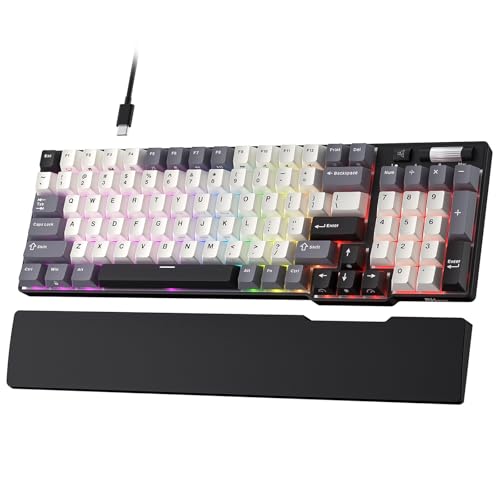
RK ROYAL KLUDGE C96 HE Mechanical Gaming Keyboard, Hall Effect Magnetic Switch,
Hall Effect magnetic switches with rapid trigger and adjustable actuation (0.01–3.5 mm)
View Today's PriceHow to Choose the Right Enthusiast Mechanical Keyboards
Choosing the right enthusiast mechanical keyboard depends on layout, switch feel, wireless needs, hot-swap support, and budget—trade-offs that shift based on your workflow and upgrade plans. A feature that’s perfect for a gamer may frustrate a coder, and compact layouts can be a dealbreaker for productivity. Our recommendation engine evaluates your specific preferences across five key dimensions and matches you to the ideal board in under 60 seconds.
About this guide
Enthusiast Mechanical Keyboards
Why Picking the Right Enthusiast Keyboard Is Tricky
Choosing enthusiast keyboards in 2026 is far more nuanced than it looks. The $80–$160 price band for enthusiast keyboards is now flooded with features that once cost $300+, like gasket mounts, Hall Effect switches, and tri-mode wireless. But not all enthusiast keyboards deliver equally: some $100 models cut corners with thin ABS keycaps or wobbly stabilizers, while other enthusiast keyboards pack in hot-swappable PCBs and south-facing RGB LEDs. Tenkeyless (TKL/80%) enthusiast keyboards dominate, but 75% and 65% enthusiast keyboards are gaining ground for those who want compactness—yet you’ll sacrifice dedicated function keys and sometimes arrow clusters. Most buyers underestimate how much switch type (linear, tactile, clicky, or Hall Effect) affects typing feel on enthusiast keyboards, or overpay for wireless when they never unplug their enthusiast keyboards. The biggest mistake? Assuming all hot-swap enthusiast keyboards are equal—some only support 3-pin switches, locking out premium 5-pin options. Price tiers matter: $50–$80 gets you solid plastic enthusiast keyboards, $80–$130 unlocks gasket mounts and better acoustics, and $130–$200 brings aluminum cases and QMK/VIA programmability to enthusiast keyboards. Overlooking these trade-offs in enthusiast keyboards leads to regret, not satisfaction.
What Actually Sets Enthusiast Boards Apart
The real differentiators in enthusiast keyboards are hot-swappability, mounting style, switch tech, and wireless flexibility. Skip soldered enthusiast keyboards unless you’re chasing the absolute lowest price or never plan to mod—hot-swap is a must for anyone who wants to experiment with enthusiast keyboards. Gasket-mount construction, now common under $130 for enthusiast keyboards, transforms typing feel with a soft, bouncy keystroke that rigid tray-mount enthusiast keyboards can’t touch. Hall Effect magnetic switches (from Gateron and Keychron) are significant upgrades for gamers using enthusiast keyboards, offering adjustable actuation and rapid-trigger—if you don’t need that, classic Cherry MX-compatible linears or tactiles still offer the broadest modding ecosystem for enthusiast keyboards. Tri-mode wireless (USB-C, Bluetooth, and 2.4GHz dongle) is worth it if you swap between devices on your enthusiast keyboards, but stick to wired if latency is your top concern. South-facing RGB and PBT shine-through keycaps are non-negotiable for custom cap sets on enthusiast keyboards—north-facing LEDs cause interference. Ducky, Keychron, and Royal Kludge lead the pack for build and firmware quality in enthusiast keyboards for 2026. Don’t get distracted by macro keys or software bloat on enthusiast keyboards unless you’ll truly use them.
How to Choose: Matching Layout, Switches, and Features to Your Workflow
Layout, switch type, wireless needs, hot-swap support, and budget all interact in ways that can make or break your experience with enthusiast keyboards. For example, if you’re a coder who needs arrow keys but values desk space, a 75% enthusiast keyboard is the sweet spot—while gamers might prefer TKL enthusiast keyboards for more mouse room. Switch feel is deeply personal: linears are best for rapid-fire gaming on enthusiast keyboards, tactiles for long-form typing, and Hall Effect for those who want to fine-tune actuation mid-game. Wireless is liberating, but only tri-mode enthusiast keyboards (like those from Keychron) deliver true flexibility—Bluetooth alone can lag in competitive play. Hot-swappability is essential for modders of enthusiast keyboards, but if you’re set on one switch, soldered enthusiast keyboards can save money. Your budget determines which features are realistic: $80–$130 is the new value sweet spot for gasket mounts and decent wireless on enthusiast keyboards, while $130+ gets you aluminum cases and QMK/VIA on enthusiast keyboards. Our quiz evaluates your layout, switch, wireless, hot-swap, and budget priorities to pinpoint the right enthusiast keyboard match. Ultimately, balancing these factors in enthusiast keyboards is the only way to avoid buyer’s remorse.
Buyer's guide
How to choose
1Core Performance Criteria
- Prioritize hot-swappable PCBs if you want to experiment with different switches or plan to mod your keyboard frequently.
- Look for gasket-mount construction in the $80–$130 range for a softer, bouncier typing feel compared to rigid tray mounts.
- Choose south-facing RGB LEDs and PBT shine-through keycaps to ensure compatibility with custom keycap sets and optimal backlighting.
- Opt for Hall Effect magnetic switches if you want adjustable actuation and rapid-trigger performance for gaming under $150.
- Check for QMK/VIA programmability if you need advanced macro support and custom key mapping, especially in the $130–$200 tier.
- Assess wireless options: tri-mode (USB-C, Bluetooth, 2.4GHz) offers maximum flexibility, while wired-only boards deliver the lowest latency.
2Build Quality and Durability
- Expect plastic cases in the $50–$80 range, but look for aluminum chassis and metal plates as you move into the $130–$200 tier.
- Double-shot PBT keycaps resist shine and wear far better than ABS, especially important for heavy typists and gamers.
- Ducky and Keychron boards consistently offer tighter stabilizers and less key wobble than most budget brands in 2026.
- Gasket-mount designs not only improve feel but also reduce long-term stress on the PCB and plate, extending lifespan.
- Check for USB-C detachable cables, which are more durable and easier to replace than micro-USB or fixed cables.
- Boards with at least a 1-year warranty and 100+ positive reviews (like those on Amazon US) indicate better long-term reliability.
3Value Analysis
- The $80–$130 price band now delivers features like gasket mounts and hot-swap PCBs that were once exclusive to $200+ boards.
- Don’t overpay for wireless if you’ll always use your keyboard at a single desk; wired-only models often offer better value.
- Keychron and Royal Kludge offer tri-mode wireless and hot-swap at prices $30–$50 lower than most boutique brands.
- Skip macro keys and OLED displays unless you have a clear workflow need—they rarely justify the extra cost for most users.
- South-facing RGB and PBT keycaps are now standard in mid-range boards, so don’t settle for less even if tempted by a lower price.
- Consider total cost: premium switches and custom keycaps can add $50–$100 to your build, so factor those into your budget.
4Use-Case Fit
- Gamers should lean toward Hall Effect or linear switches for rapid actuation, and prioritize tri-mode wireless for multi-device setups.
- Coders and writers benefit from tactile switches and layouts with arrow keys—75% or TKL is often the best compromise.
- Travelers or hybrid workers should consider 65% or 75% layouts for portability, but check if you’ll miss dedicated F-keys.
- If you swap switches often, hot-swappable PCBs are essential—soldered boards are only worth it for single-switch purists.
- Macro support and QMK/VIA programmability matter most for power users who automate workflows or use niche software.
- RGB lighting is nearly universal, but south-facing LEDs are a must if you plan to use aftermarket keycaps for aesthetics.
5Common Mistakes to Avoid
- Assuming all hot-swap boards support both 3-pin and 5-pin switches—some budget models only fit 3-pin, limiting upgrade options.
- Overlooking stabilizer quality: cheap boards often have rattly spacebars that drive you crazy after a week of use.
- Buying a compact 65% layout without realizing you’ll miss arrow keys or dedicated function rows for productivity tasks.
- Paying extra for wireless when you never unplug your keyboard—wired boards are often more stable and cost less.
- Ignoring switch feel: picking the wrong type (linear, tactile, clicky, Hall Effect) can ruin the typing experience.
- Forgetting to check for QMK/VIA support if you want advanced remapping or macros—many mid-range boards lack this feature.
6Maintenance and Longevity
- Hot-swappable sockets make cleaning and replacing worn switches much easier, extending the usable life of your keyboard.
- Double-shot PBT keycaps last years without developing shine, while ABS caps often look worn after a few months of heavy use.
- Gasket-mount construction reduces vibration and stress on internal components, helping prevent PCB and plate fatigue over time.
- Detachable USB-C cables are less likely to fray or break, and replacements are easy to source if needed.
- Boards with easily accessible stabilizers allow for periodic lubing and maintenance, keeping keys smooth and quiet for years.
- Choose brands with strong community support (like Ducky and Keychron) for easier sourcing of replacement parts and firmware updates.
FAQ
Frequently asked questions
Is it worth paying extra for Hall Effect magnetic switches?
If you’re a gamer who values adjustable actuation and rapid-trigger performance, Hall Effect switches from brands like Gateron and Keychron are absolutely worth the premium—often under $150. These switches let you fine-tune actuation points and enable features like rapid-fire, which traditional mechanical switches can’t match. For typists or those uninterested in gaming performance, classic linear or tactile switches remain a better value. Only pay extra for Hall Effect if you’ll actually use the advanced features, otherwise you’re spending more for tech you won’t leverage.
How does Keychron compare to Ducky for enthusiast keyboards?
Keychron leads on wireless flexibility and hot-swappable support, offering tri-mode (USB-C, Bluetooth, 2.4GHz) connectivity and Hall Effect switch options in the $100–$150 range. Ducky, on the other hand, is the gold standard for build quality, stabilizer tuning, and out-of-the-box typing feel—especially with their One 3 series. If you want deep programmability and portability, Keychron is tough to beat. For pure typing experience and long-term durability, Ducky remains king in 2026. Both brands offer double-shot PBT keycaps and robust community support.
What layout is best for coding and productivity?
For coding and productivity, Tenkeyless (TKL/80%) and 75% layouts are the sweet spot. TKL keeps the full F-row and arrow keys, which are essential for shortcuts and navigation, while freeing up desk space compared to full-size boards. 75% layouts shrink the footprint further but retain most productivity-critical keys. Avoid 65% or smaller unless you’re certain you won’t miss dedicated function or arrow keys. Brands like Keychron and Ducky both offer excellent TKL and 75% options with hot-swap and programmable features in 2026.
Are hot-swappable PCBs reliable for long-term use?
Modern hot-swappable PCBs from reputable brands like Keychron, Royal Kludge, and Ducky are highly reliable and rated for thousands of switch changes. The sockets are designed to withstand frequent swaps without degrading. However, extremely cheap boards may use lower-quality sockets that loosen over time. For heavy modders, look for boards with Kailh or Gateron hot-swap sockets and strong community feedback. As long as you avoid excessive force and stick to supported switch types, hot-swappable boards should last as long as soldered ones.
Do I need QMK/VIA programmability?
QMK/VIA programmability is essential if you want to remap keys, create complex macros, or customize layers for specific software. For power users, coders, and gamers who automate workflows, it’s a must-have. Most premium boards ($130–$200) now include this feature, but many budget and mid-range models do not. If you only need basic remapping or never change your layout, you can skip it and save money. Always check the product listing—Keychron and Ducky’s higher-end models are safe bets for QMK/VIA support.
How does wireless performance compare between Bluetooth and 2.4GHz?
Bluetooth is convenient for switching between devices but introduces noticeable input lag in fast-paced gaming or real-time typing. 2.4GHz wireless (via USB dongle) offers near-wired latency and is the preferred choice for gamers or anyone sensitive to delay. Tri-mode boards let you choose the best connection for your needs. Brands like Keychron and Royal Kludge offer reliable 2.4GHz performance under $150. If you only work at a desk, wired is still the gold standard for absolute stability.
Which brands offer the best value in 2026?
Keychron, Royal Kludge, and Ducky are the top value picks in 2026. Keychron stands out for tri-mode wireless and Hall Effect support at aggressive prices. Royal Kludge delivers hot-swap and wireless features in the $70–$110 range, making them ideal for budget-conscious buyers. Ducky’s One 3 series commands a premium but justifies it with unmatched build quality and tuning. All three brands have strong community support, frequent firmware updates, and many layouts and switch options.
Best Enthusiast Mechanical Keyboards By Category
Compare Enthusiast Mechanical Keyboards
Related Guides
Controller Lanyards
Device compatibility, attachment style, comfort, and value—get matched to the right lanyard for your controller and gaming habits.
Esports Gaming Mice Bundles
Matched to your genre, budget, keyboard size, connection, and mousepad needs—get the right esports bundle for your setup.
Gaming Keyboards
Switch feel, layout, RGB, and budget—get matched to the perfect gaming keyboard for your setup and play style.
Gaming Routers
Wi-Fi standard, home size, device load, and gaming platform—all matched to your budget for the perfect gaming router.