Skip the research trap. Get your adjustable dumbbells in 60 seconds.
We scored 200+ adjustable dumbbells across 5 dimensions — answer 5 quick questions and we'll match you to YOUR best pick.

Powered by DecisionScore™
Each product is evaluated across 18 weighted criteria — covering performance, value, build quality, and real-world usability. Your quiz answers re-weight the criteria to match what matters most to you, so two people can get different #1 picks from the same data.
See the DecisionScore methodology →Find your perfect adjustable dumbbells
5 quick questions. No quiz-takes-10-minutes trap. A personalized match from 18 scored picks — with clear reasoning for every recommendation.
What is the heaviest weight you plan to lift with each dumbbell?
Selecting the right weight range ensures your dumbbells support your workouts. Lighter ranges (up to 25 lb) suit beginners and rehab, mid ranges (26–50 lb) cover general fitness, heavier options (51–80 lb) accommodate strength progression, and extreme ranges (81 lb or more) serve experienced lifters. If in doubt, choose a mid range.
- Think about your heaviest current lift and where you want to be in a year—it's easy to outgrow lighter sets.
- If you plan on compound lifts (like bench or rows), 50 lbs per hand is a good baseline for most users.
- Lighter sets (up to 25 lbs) are great for rehab or toning, but limit long-term strength progress.
As an Amazon Associate and affiliate partner we earn from qualifying purchases. Links on this page may earn us a commission at no extra cost to you. Full disclosure
Not ready for the quiz? Here are our overall top picks
These are our top-rated picks overall. For a recommendation matched to YOUR specific needs,

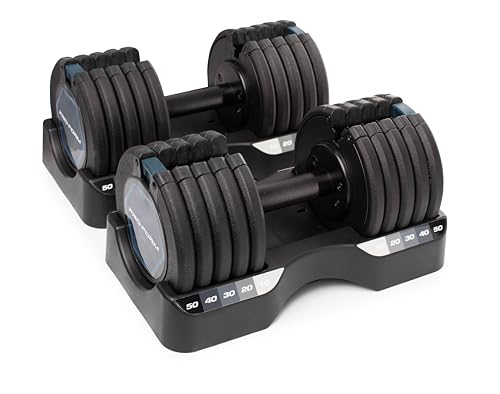
How to Choose the Right Adjustable Dumbbells
Choosing the right adjustable dumbbells depends on your strength goals, space constraints, preferred adjustment style, and budget—trade-offs that shift based on your training habits and future plans. A feature that’s perfect for rapid supersets might be wrong for heavy powerlifting, and compact sets often sacrifice max weight. Our recommendation engine evaluates your specific needs across five key dimensions and matches you to the right adjustable dumbbell set in under 60 seconds.
About this guide
Adjustable Dumbbells
Why Adjustable Dumbbells Are a Surprisingly Tricky Buy
Adjustable dumbbells promise to replace an entire rack with a single compact set, but the reality is more complex than most buyers expect. You’re not just picking a weight range—models vary wildly in maximum load, adjustment speed, and ergonomics. For instance, the BowFlex SelectTech 552 covers 5–52.5 lbs per hand in 5 lb increments, while PowerBlock’s EXP 50 Series is expandable up to 90 lbs for serious lifters. Some sets, like Core Home Fitness, use twist dials for one-handed changes, but others rely on slower screw-on collars or selector pins. Price tiers matter: under $300 often means coarse 10 lb jumps or plastic-heavy builds, while $400–$500 unlocks finer increments and metal construction. Most buyers get tripped up by ignoring handle width—wider grips (14–16 inches) can feel awkward for skull crushers or presses. And dropping these dumbbells, unlike fixed weights, is a recipe for broken mechanisms. Every choice—mechanism, weight range, handle design—comes with trade-offs that impact daily use.
What Actually Sets Adjustable Dumbbells Apart
The real differentiators in adjustable dumbbells are the adjustment mechanism, increment size, build materials, and overall footprint. Dial and twist systems (like BowFlex and Core) let you change weights in seconds—a huge advantage for supersets or progressive overload. Pin-based models (PowerBlock) are robust but slower mid-workout. Skip screw-on collars unless you’re on a tight budget or need ultra-fine micro-loading; they’re tedious for fast-paced routines. Increment size is make-or-break: 5 lb or finer (BowFlex, Core) prevents strength plateaus, while 10 lb jumps (common under $200) are too coarse for most. Build matters more than most realize—plastic-heavy sets crack under heavy use, so prioritize all-metal plates and grips if you lift over 50 lbs per hand. Handle shape isn’t just comfort: block-style caged handles add stability but limit two-handed moves, while traditional open handles feel natural for presses and curls. Smart features like digital tracking sound cool but rarely justify the price unless you’re obsessed with data.
How to Choose: Balancing Specs, Space, and Training Style
Selecting adjustable dumbbells in 2026 is all about matching your real training needs with your space and budget. Room size and storage dictate whether a compact set (like Core’s shorter design at lighter weights) or a bulkier, expandable model (PowerBlock EXP) makes sense. Your strength goals—rehab, general fitness, or heavy lifting—directly affect which max weight and increment size are must-haves. Budget is a hard constraint: $200–$300 sets often sacrifice durability or adjustment speed, while $350–$450 is the sweet spot for reliable, fast-adjusting models with 50+ lb capacity. The quiz evaluates your max weight needs, adjustment preference, increment size, handle style, and secondary features like expandability or compactness. The smartest approach: start with your heaviest planned lift, then work backward to the fastest, most durable mechanism you can afford. Don’t get distracted by smart features or ultra-wide ranges if you’ll never use them—focus on daily usability and the exercises you actually do.
Buyer's guide
How to choose
1Core Performance Criteria
- Choose a set with at least a 50 lb max per dumbbell if you plan to progress beyond beginner routines—25 lb sets limit long-term gains.
- Finer weight increments (2.5–5 lb) like those on BowFlex SelectTech 552 prevent frustrating strength gaps and are essential for steady progress.
- Dial or twist mechanisms allow for rapid weight changes, which is crucial for supersets or circuit workouts where speed matters.
- Pin selector systems (PowerBlock) offer solid reliability but are slower to adjust mid-workout compared to dial-based models.
- Check the minimum starting weight; some sets start at 10 lbs, which can be too heavy for certain rehab or isolation exercises.
- Wider dumbbells (14–16 inches) can feel awkward for close-grip or overhead moves, so measure your range of motion before buying.
2Build Quality and Durability
- Prioritize all-metal plates and handles for long-term durability—plastic-heavy builds are prone to cracking, especially above 40 lbs per hand.
- BowFlex and PowerBlock use premium metal and urethane coatings, which withstand daily use better than budget brands with exposed plastic.
- Avoid dropping adjustable dumbbells, as sensitive mechanisms in dial and pin systems are easily damaged compared to fixed weights.
- Check user reviews for handle grip quality—non-slip, knurled handles are safer and more comfortable for sweaty, high-rep sessions.
- Inspect the adjustment cradle: Core Home Fitness has reported issues with cradles sticking at heavier weights, impacting reliability.
- Warranty length varies by brand; BowFlex and PowerBlock typically offer longer coverage, reflecting higher confidence in their build.
3Value Analysis and Price Tiers
- The sweet spot for value in 2026 is $350–$450 for sets offering 50+ lb per hand, fast adjustment, and robust build quality.
- Under $300, expect trade-offs: coarser 10 lb increments, plastic parts, or lower max weights that may not support long-term strength goals.
- Above $500, you’re mainly paying for minor features like micro-increments or smart connectivity, which most users won’t fully utilize.
- BowFlex SelectTech 552 frequently drops to $399 during sales, making it a standout for performance and value in the mid-premium range.
- Core Home Fitness and PowerBlock models often bundle storage trays or stands—factor these extras into your total cost comparison.
- Don’t overlook resale value: premium brands maintain higher used prices, so you can recoup more if you upgrade later.
4Use-Case Fit and Training Style
- Choose lighter sets (up to 25 lbs) for rehab, beginners, or isolation work—heavier models are overkill and harder to handle for small movements.
- If you do lots of drop sets or circuit training, prioritize dial or twist systems for near-instant weight changes between exercises.
- Block or caged handles (PowerBlock) are ideal for stability in heavy lifts but can restrict wrist rotation in curls and two-handed moves.
- Traditional open handles feel most like classic dumbbells and suit presses, rows, and curls for a natural training experience.
- If space is tight, look for compact sets like Core Home Fitness, which are shorter at lighter weights and easier to store.
- Smart features (tracking, voice control) are only worth it if you’re data-driven; most users never use these after the first month.
5Common Mistakes and Pitfalls
- Many buyers underestimate their future strength gains—buying a set that tops out at 25 lbs often means an expensive upgrade within a year.
- Ignoring adjustment speed leads to frustration; slow screw-on collars break workout flow, especially for supersets or shared use.
- Assuming all adjustable dumbbells fit standard racks—wider models may not store easily and can clutter small spaces.
- Overlooking handle width can make certain exercises awkward; always check product specs for overall length before purchasing.
- Choosing plastic-heavy builds to save money often results in breakage, especially if you’re tempted to drop the weights after sets.
- Neglecting warranty details can bite you later—mechanism failures are not uncommon, so prioritize brands with strong support.
6Maintenance and Longevity
- Regularly check and tighten adjustment mechanisms, especially on screw-on or pin-based systems, to prevent accidental plate drops.
- Wipe down handles and plates after each session to prevent sweat corrosion—metal and urethane last longer with basic care.
- Store dumbbells in their cradle or on a rack to protect delicate adjustment components from accidental knocks or drops.
- Avoid dropping adjustable dumbbells entirely; even premium models like BowFlex and PowerBlock can suffer irreparable mechanism damage.
- Inspect for plate rattling or sticking—early signs of wear that, if ignored, can lead to full mechanism failure over time.
- Replace worn cradles or trays promptly; Core Home Fitness users report that sticking cradles at heavy weights can quickly worsen if not addressed.
FAQ
Frequently asked questions
Is it worth paying extra for dial or twist adjustment systems?
Yes, dial or twist adjustment systems like those found on BowFlex SelectTech 552 and Core Home Fitness sets are worth the premium if you value speed and convenience. They let you change weights in seconds, which is crucial for supersets or shared workouts. Pin or screw-on systems are slower and can disrupt your training flow, especially if you switch weights frequently. For most home users, this speed is one of the biggest quality-of-life upgrades over cheaper models.
How does BowFlex compare to PowerBlock for home use?
BowFlex and PowerBlock are both top choices, but they suit slightly different needs. BowFlex SelectTech 552 offers a more traditional dumbbell feel, faster dial adjustments, and 5–52.5 lb range in 5 lb increments. PowerBlock’s EXP series is expandable up to 90 lbs and uses a compact, caged handle design with pin selectors—great for heavy lifters but less natural for curls and presses. BowFlex wins for ergonomics and speed; PowerBlock excels in max weight and stability.
What weight range should I choose for progressive strength training?
For progressive strength training, select a set that allows at least 50 lbs per dumbbell, ideally with 2.5–5 lb increments. This range covers most compound lifts and enables steady progression without big jumps. Sets like BowFlex SelectTech 552 (5–52.5 lbs) or PowerBlock EXP (expandable to 90 lbs) are ideal. Avoid sets that only go up to 25 lbs unless you’re focused solely on rehab or toning, as you’ll quickly outgrow them.
Are plastic components a dealbreaker for adjustable dumbbells?
Plastic components are a major downside, especially for heavier or high-frequency use. They keep costs down but are prone to cracking and wear, particularly if you ever drop the dumbbells. All-metal or metal-with-urethane-coating models, like those from BowFlex and PowerBlock, last significantly longer and feel more stable. If your budget allows, always opt for metal construction—plastic-heavy builds are best reserved for light, occasional use.
Why do some adjustable dumbbells feel awkward for certain exercises?
Many adjustable dumbbells are wider (14–16 inches) than standard fixed dumbbells, which can make exercises like skull crushers, curls, or close-grip presses feel awkward. Handle design also plays a role: block-style caged handles offer stability but restrict wrist movement, while traditional open handles feel more natural. Always check the overall length and test the grip style if possible to ensure comfort for your favorite exercises.
How does Core Home Fitness compare to BowFlex and PowerBlock?
Core Home Fitness stands out for its one-handed twist adjustment and compact design at lighter weights, making it ideal for small spaces and rapid weight changes. However, users report that the cradle can be tricky to use at heavier weights and may require careful handling. BowFlex offers a more traditional feel and broader range, while PowerBlock excels in expandability and heavy lifting. Core is a great choice if you prioritize speed and space-saving.
Can I drop adjustable dumbbells like fixed weights?
No, dropping adjustable dumbbells is a common and costly mistake. Unlike fixed dumbbells, the adjustment mechanisms—especially in dial and pin systems—are sensitive to impact and can break or jam if dropped. This is true even for premium models like BowFlex and PowerBlock. Always set them down gently, and consider using foam floor tiles or mats to protect both your equipment and your floors.
Related reading
Best Adjustable Dumbbells By Category
Related Guides
Bike Mats
Matched to your bike type, floor surface, noise needs, material preference, and budget for the perfect indoor cycling mat.
Bike Trainers
Matched to your riding style, noise tolerance, tech needs, and space—get a bike trainer that fits your real routine.
Cold Plunge Tubs
Insulation, chilling method, space, and budget—get matched to the cold plunge tub that fits your recovery style and setup.
Compact Home Gyms
Matched to your space, resistance needs, tech comfort, and how you actually want to train—no more guessing or wasted space.