Skip the research trap. Get your compact air purifier fans in 60 seconds.
We scored 200+ compact air purifier fans across 5 dimensions — answer 5 quick questions and we'll match you to YOUR best pick.
Powered by DecisionScore™
Each product is evaluated across 18 weighted criteria — covering performance, value, build quality, and real-world usability. Your quiz answers re-weight the criteria to match what matters most to you, so two people can get different #1 picks from the same data.
See the DecisionScore methodology →- 2‑in‑1 bladeless fan with high‑density filters capturing 99.95% of fine particles
- 12 speeds and multi‑oscillation angles (30°, 60°, 120°) for personalised cooling【447808852217624†L88-L93】
- Ultra‑silent operation at 32 dB on minimal speed【447808852217624†L85-L87】
Find your perfect compact air purifier fans
5 quick questions. No quiz-takes-10-minutes trap. A personalized match from 20 scored picks — with clear reasoning for every recommendation.
Which type of climate control do you need beyond purification?
Cooling-only units provide a refreshing breeze while filtering the air. Heat & cool units add warmth for winter. High-end climate control models offer advanced features like humidity regulation or formaldehyde removal. If you’re unsure, cooling-only is a safe choice.
- Cooling-only units are usually lighter, cheaper, and quieter—ideal for summer or small bedrooms.
- Heat & cool models, like Dyson HP1, cost more but provide comfort year-round in variable climates.
- Advanced climate control adds features like humidity regulation or formaldehyde removal—overkill unless you have special health needs.
As an Amazon Associate and affiliate partner we earn from qualifying purchases. Links on this page may earn us a commission at no extra cost to you. Full disclosure
Not ready for the quiz? Here are our overall top picks
These are our top-rated picks overall. For a recommendation matched to YOUR specific needs,
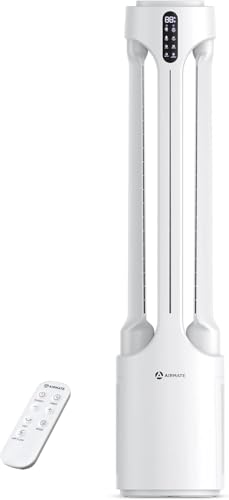
AIRMATE Air Purifier Bladeless Tower Fans, 1500CFM Large Air Volume, 45" 2-in-1
2‑in‑1 bladeless fan with high‑density filters capturing 99.95% of fine particles
View Today's Price
Blueair Blue Pure 411+ Genuine
Adds auto mode and sensor to the Blue Pure Fan platform
View Today's Price
U ULTTY Bladeless Tower Fan and Air Purifier in one, Quiet Tower Fan with
Bladeless tower fan with HEPA filtration and UV sterilisation
View Today's PriceHow to Choose the Right Compact Air Purifier Fans
Choosing the right compact air purifier fan depends on your room size, filtration needs, climate control preferences, and budget—trade-offs that shift based on your space and sensitivity. A feature that’s perfect for a small bedroom may be wasted in a large living room, and smart controls are only worth it if you’ll use them. Generic top-10 lists miss these crucial interactions. Our recommendation engine evaluates your specific needs across five dimensions and matches you to the ideal purifier fan in under 60 seconds.
About this guide
Compact Air Purifier Fans
Why Picking the Right Compact Air Purifier Fan Is Tricky
Selecting compact air purifier fans in 2026 is a balancing act that trips up even savvy shoppers. Compact air purifier fans combine two or more technologies—purification, cooling, sometimes heating or humidifying—into a single chassis, forcing you to weigh real trade-offs. For example, a $150 Blueair Blue Pure Mini Max excels at purifying up to 100 sq ft, but step up to a $450 Dyson Purifier Hot+Cool and you get heating and advanced airflow, often at the cost of higher noise and bulk. Many buyers wrongly assume any bladeless fan cleans air, but unless compact air purifier fans have a genuine HEPA filter and a Clean Air Delivery Rate (CADR) above 100 for smoke and dust, you’re just recirculating pollutants. Another pitfall: thinking a powerful fan means quiet operation—when in reality, high-airflow compact air purifier fans like the Dyson HP1 can still hit 40dB on max. Control options for compact air purifier fans vary wildly, from basic remote-only units to app-driven smart fans with sensors. Most people get tripped up by room coverage: a Blueair Mini Restful is perfect for a 100 sq ft bedroom, but falls flat in a 200 sq ft living room if you rely on compact air purifier fans not sized for the space. Don’t let marketing hype or one-size-fits-all lists steer you wrong—every decision with compact air purifier fans is about matching specs to your real needs.
What Actually Separates the Best Compact Air Purifier Fans
The real differentiators in compact air purifier fans come down to filtration technology, airflow design, and smart controls. HEPA filtration is non-negotiable if you want compact air purifier fans that trap dust, pollen, and smoke—models like the Blueair Mini Restful and AEG Pure 5000 Compact both remove over 99% of airborne particles, while cheaper compact air purifier fans with only pre-filters or iFD tech (like Honeywell AirGenius 5) fall short for heavy smoke or allergies. CADR is more important than the advertised room size: compact air purifier fans with a smoke CADR above 100 mean faster, more reliable cleaning. For cooling, Dyson’s Air Multiplier tech delivers smooth, bladeless airflow and quieter oscillation, but you pay a premium—skip Dyson compact air purifier fans if you don’t need heating or advanced climate control. Auto modes and onboard sensors, found in AEG and Dyson compact air purifier fans, adjust speed based on air quality, while budget compact air purifier fans like Vissani VK-6105 lack these smarts but keep costs down. Don’t overpay for features you’ll never use: if you just want a simple, portable compact air purifier fan for a desk, Blueair’s Mini Max or Mini Restful are top picks. Prioritize compact air purifier fans with a washable pre-filter if you want to save on annual filter costs, but accept that true HEPA performance in compact air purifier fans usually means $50–$100/year in replacements.
How to Choose: Key Decision Factors and Interactions
Room size, filtration needs, and climate control features are deeply intertwined when picking compact air purifier fans. If you’re outfitting a small bedroom (under 100 sq ft), compact air purifier fans like the Blueair Mini Restful or Vissani VK-6105 offer adequate CADR and portability, but for open-plan living rooms, you’ll need compact air purifier fans such as the Dyson HP1 or AEG Pure 5000 Compact to maintain air quality. Budget is a hard constraint: under $100 means skipping sensors and smart features in compact air purifier fans, while $250+ unlocks auto-modes and app integration. Filter type matters for allergies and smoke—compact air purifier fans with HEPA plus carbon (as in Vissani and AEG) beat basic pre-filters for odor and VOC removal. Noise tolerance is personal; if you’re noise-sensitive, check real dB ratings (Dyson HP1 stays under 40dB on high, while some compact air purifier fans rattle above 45dB). Finally, consider form factor: slim tower compact air purifier fans fit tight spaces, but large towers or bladeless compact air purifier fans may be safer for kids and pets. Our quiz weighs these trade-offs—room size, filtration, climate control, smart features, and design—to guide you to the best compact air purifier fans for your needs. Don’t underestimate how these factors interact: a feature that’s essential in one context for compact air purifier fans may be wasted in another.
Buyer's guide
How to choose
1Core Performance Criteria
- Always check for a true HEPA filter and a CADR above 100 for smoke and dust if you want effective purification in small rooms.
- If you need cooling power, prioritize models with Air Multiplier or similar bladeless technology, as found in Dyson and Blueair fans.
- Auto mode and onboard sensors, like those in AEG Pure 5000 Compact, ensure the fan adjusts speed based on real-time air quality.
- For allergy or smoke-prone homes, combine HEPA with activated carbon filters, such as in Vissani VK-6105 or AEG Pure 5000 Compact.
- Don’t rely on room size claims alone—match CADR to your actual square footage for reliable results and avoid underpowered units.
- Noise matters: Dyson HP1 stays under 40dB on high, while some budget fans exceed 45dB, which can disrupt sleep or work.
2Build Quality and Durability
- Blueair and Dyson models feature robust construction and quality plastics, while some budget fans feel flimsier and develop rattles over time.
- Look for washable pre-filters to extend filter life and reduce maintenance costs, especially in high-dust or pet environments.
- Units under 4 lbs, like Blueair Mini Restful, are easy to move but may tip over more easily than heavier, wider-base models.
- Check for solid handles and stable bases if you plan to move the unit between rooms frequently or use it on a desk.
- Avoid models with thin, snap-on filter covers, as these can break with repeated filter changes—prefer magnetic or hinged designs.
- Warranty length varies: Dyson typically offers two years, while Blueair and AEG provide one year—longer coverage signals better build confidence.
3Value Analysis and Price Tiers
- The best value in 2026 sits between $120 and $250, where Blueair and AEG deliver 99%+ filtration and smart features without Dyson’s markup.
- Under $100, expect to sacrifice auto sensors and app integration, but Vissani VK-6105 still offers HEPA and carbon filtration for small rooms.
- Dyson’s $450+ models add heating and advanced controls, but skip these if you don’t need year-round climate control or large room coverage.
- Annual filter costs range from $50 to $100 for true HEPA units; washable filters save money but may underperform after a year of use.
- Don’t overpay for features like heating or humidity control unless you truly need them—basic cooling and purification suffice for most users.
- Watch for seasonal discounts on Blueair and AEG, as prices can drop 10–15% during spring and fall clearance sales.
4Use-Case Fit and Room Coverage
- For bedrooms or desks under 100 sq ft, Blueair Mini Restful and Blue Pure Mini Max are ideal for portability and effective purification.
- Living rooms up to 150 sq ft require higher CADR and possibly oscillation—AEG Pure 5000 Compact and Dyson HP1 are strong contenders.
- If you want a portable unit for multiple rooms, prioritize lightweight models with handles, but check if coverage matches your largest space.
- Skip compact fans for open-plan areas; even the best minis lose 50% effectiveness above their rated coverage.
- Bladeless designs are safer for homes with kids or pets, while slim towers fit tight spaces but may have less airflow.
- If you have allergies or pets, always choose HEPA plus carbon filtration—avoid iFD-only or pre-filter-only models for best results.
5Common Mistakes and Pitfalls
- Don’t assume any bladeless fan purifies air—many lack true HEPA filters and only circulate, not clean, the air.
- Buyers often overestimate coverage: a 100 sq ft-rated fan won’t clean a 200 sq ft room, no matter the brand.
- Ignoring CADR is a classic error—always check smoke and dust CADR, not just the manufacturer’s room size claims.
- Skipping filter cost calculations leads to surprises; budget $50–$100/year for HEPA, or choose washable filters for lower ongoing expenses.
- Assuming more power means less noise is false—high-airflow fans can be noisy, so check decibel ratings if quiet is a priority.
- Overpaying for smart features is common; if you won’t use app controls or voice assistants, stick to simpler remote-only models.
6Maintenance and Longevity
- Replace HEPA filters every 6–12 months for peak performance; Blueair and Dyson filters are easy to swap but not interchangeable.
- Washable pre-filters, like those on Blueair models, cut costs but require monthly cleaning to maintain airflow and filtration efficiency.
- Check for filter change indicators—AEG and Dyson include these, so you won’t forget and compromise air quality.
- Keep fan inlets and outlets dust-free using a microfiber brush to prevent motor strain and extend the unit’s lifespan.
- Avoid using scented pads or oils unless the manufacturer approves, as these can clog filters and void warranties.
- Store unused units in a dry, dust-free area to prevent mold or motor corrosion, especially if you only use them seasonally.
FAQ
Frequently asked questions
Is a true HEPA filter worth paying extra for in compact air purifier fans?
Absolutely—true HEPA filters capture 99.97% of particles down to 0.3 microns, including dust, pollen, and smoke. Models like the Blueair Mini Restful and AEG Pure 5000 Compact consistently outperform cheaper units with only pre-filters or iFD tech, especially for allergy and asthma relief. While HEPA-equipped fans cost more upfront and require $50–$100/year in filter replacements, the improvement in air quality is significant. If you’re sensitive to allergens or live in a smoky area, paying extra for genuine HEPA filtration is a smart investment.
How does the Blueair Blue Pure Mini Max compare to the Dyson Purifier Hot+Cool HP1?
The Blueair Blue Pure Mini Max is a top pick for small rooms (up to 100 sq ft), offering excellent HEPA filtration, portability, and quiet operation at around $150. The Dyson Purifier Hot+Cool HP1, at $450, adds bladeless cooling, heating, and advanced airflow for spaces up to 200 sq ft. Dyson also features auto modes and app integration, but it’s bulkier and pricier. Choose Blueair for simplicity and value in compact spaces; opt for Dyson if you need year-round climate control and smart features in a larger room.
What CADR rating do I need for a bedroom or small office?
For bedrooms or offices under 150 sq ft, look for a compact air purifier fan with a smoke or dust CADR of at least 100. This ensures the device can effectively clean the air in your space within an hour. Models like the Blueair Mini Max and AEG Pure 5000 Compact meet or exceed this threshold. Avoid units that only list room size without a CADR figure, as actual purification speed may be much lower than claimed. Always match CADR to your real square footage for best results.
Are app-enabled or smart air purifier fans worth the premium?
App-enabled and smart air purifier fans, such as the Dyson HP1 and AEG Pure 5000 Compact, offer features like real-time air quality monitoring, scheduling, and auto-adjustment based on sensor data. These are especially useful if you want set-and-forget operation or remote control from your phone. However, if you’re comfortable with manual or remote-only controls and don’t need automation, you can save $100–$200 by choosing simpler models like the Blueair Mini Restful. Pay for smart features only if you’ll actually use them.
How do filter replacement costs compare among leading brands?
Annual filter replacement costs for compact air purifier fans typically range from $50 to $100 for true HEPA models like Blueair and Dyson. Washable pre-filters, found on Blueair and some Honeywell units, reduce ongoing expenses but may not match HEPA performance over time. Dyson filters tend to be more expensive but last longer, while budget brands like Vissani keep costs low but require more frequent changes. Always factor in filter costs when comparing total ownership value, especially if you run your fan year-round.
Which compact air purifier fan is best for pet owners?
Pet owners should prioritize models with both HEPA and activated carbon filtration to tackle dander, hair, and odors. The AEG Pure 5000 Compact and Vissani VK-6105 both combine these filter types and perform well in expert tests for removing pet-related pollutants. Bladeless designs, like Dyson HP1, are also safer for homes with curious pets. Avoid units with only basic pre-filters, as they won’t effectively capture fine pet allergens or neutralize odors from litter boxes or bedding.
Can I use a compact air purifier fan in a large living room or open-plan space?
Most compact air purifier fans are rated for spaces up to 150 sq ft—pushing them into larger rooms dramatically reduces their effectiveness. For open-plan areas, even the best minis like the Blueair Mini Max will only clean a fraction of the air, leaving pollutants behind. If you need coverage for 200+ sq ft, invest in a larger unit like the Dyson HP1 or consider multiple smaller fans placed strategically. Always match the device’s CADR and rated coverage to your largest room for reliable results.
Best Compact Air Purifier Fans By Category
Related Guides
AC Units
Room size, installation, noise, budget, and smart features—get matched to the AC unit that fits your space and lifestyle.
Best Ceiling Fans
Room size, ceiling height, style, and lighting—get matched to the perfect ceiling fan for your space and comfort.
Dehumidifiers
Room size, drainage, noise, and convenience—get matched to the dehumidifier that actually fits your space and lifestyle.
Door Sweeps
Door location, installation method, seal type, and budget—all matched to your needs for the perfect draft and pest barrier.