Skip the research trap. Get your inflatable kayaks in 60 seconds.
We scored 300+ inflatable kayaks across 5 dimensions — answer 5 quick questions and we'll match you to YOUR best pick.

Powered by DecisionScore™
Each product is evaluated across 18 weighted criteria — covering performance, value, build quality, and real-world usability. Your quiz answers re-weight the criteria to match what matters most to you, so two people can get different #1 picks from the same data.
See the DecisionScore methodology →- Complete starter kit — seat, paddle, hand pump, and storage carry bag included
- Suitable for adults, kids, and families
- Durable inflatable PVC construction for calm lake use
Find your perfect inflatable kayaks
5 quick questions. No quiz-takes-10-minutes trap. A personalized match from 27 scored picks — with clear reasoning for every recommendation.
How many paddlers will use this kayak?
Tandem kayaks can usually also be paddled solo by adjusting seat positions, offering more versatility.
- Solo kayaks are lighter and fit in smaller cars or closets.
- Tandem kayaks can be paddled solo if you adjust the seat position.
- Convertible models offer flexibility but are heavier and bulkier to transport.
As an Amazon Associate and affiliate partner we earn from qualifying purchases. Links on this page may earn us a commission at no extra cost to you. Full disclosure
Not ready for the quiz? Here are our overall top picks
These are our top-rated picks overall. For a recommendation matched to YOUR specific needs,
Bestway Hydro-Force 12'6" x 39" Rapid X3 Inflatable Kayak Set | Fits Up to 3
Complete starter kit — seat, paddle, hand pump, and storage carry bag included
View Today's Price
Driftsun Teton 120 Hard Shell Kayak, 2 to 3 Person Sit On Top, Perfect Fishing
Check today’s price →11 ft sit-on-top design for easy entry and exit
View Today's Price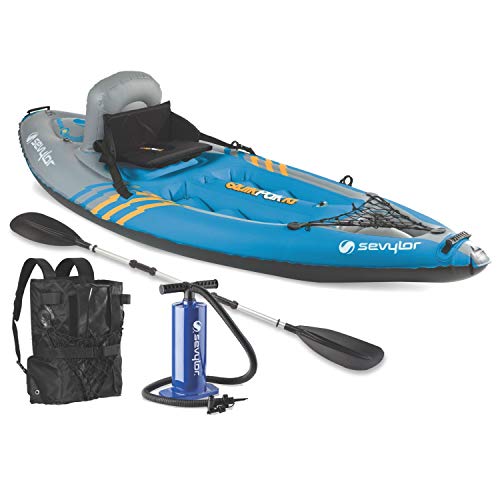
Sevylor QuickPak K1 1-Person Inflatable Kayak, Kayak Folds into Backpack with
Innovative backpack system — entire kayak folds into a wearable backpack
View Today's PriceHow to Choose the Right Inflatable Kayaks
Choosing the right inflatable kayak depends on construction quality, paddler capacity, intended water type, and budget—trade-offs that shift based on your paddling style and storage constraints. A feature that’s perfect for lake touring may be a liability on rocky rivers, and a budget model’s limitations can frustrate frequent users. Our recommendation engine evaluates your specific needs across 18 decision dimensions and matches you to the right inflatable kayak in under 60 seconds.
About this guide
Inflatable Kayaks
Why Inflatable Kayak Shopping Is Trickier Than It Looks
Choosing inflatable kayaks in 2026 is a balancing act between portability, performance, and longevity—much tougher than most buyers expect. The $100–$400 price band is packed with inflatable kayaks, but the difference between a $120 Intex Explorer K2 and a $400 Advanced Elements or Driftsun inflatable kayak is night and day. Entry-level inflatable kayaks often use thinner 21–28 gauge PVC, which can puncture easily and develop slow leaks after just a season, especially if you paddle rocky rivers. Many buyers are lured by long hulls or tandem seating in inflatable kayaks but overlook critical specs like floor PSI (rigidity), valve type (Boston vs. screw-cap), and included pump quality. Accessories for inflatable kayaks, like paddles and seats, vary wildly in comfort and durability—budget bundles often disappoint. Most shoppers underestimate how much construction material (standard PVC vs. 3-ply laminate vs. drop-stitch) impacts tracking, stability, and lifespan in inflatable kayaks. And weight matters: a tandem inflatable kayak over 35 lbs can be a pain to carry, even if the packed size looks manageable. Don’t get fooled by star ratings alone—dig into the details of inflatable kayaks or you’ll end up with a pool toy, not a real kayak.
What Actually Sets Inflatable Kayaks Apart
The real differentiators in inflatable kayaks are construction quality, floor design, and accessory integration—not just length or color. Drop-stitch floors, now available even on some $220 G sát Explorer and $400 Sea Eagle inflatable kayaks, deliver hardshell-like rigidity and tracking that basic PVC chambers in inflatable kayaks simply can’t match. Skip any inflatable kayak with a floor rated under 10 PSI if you want real performance; a 12' inflatable kayak with a 12 PSI drop-stitch floor will outperform a 15' model with a soft, low-pressure base every time. Brands like Advanced Elements and Driftsun stand out for their use of aluminum rib-frame tech and 3-layer PVC in their inflatable kayaks, which resists punctures and UV damage far better than single-layer builds from budget inflatable kayak brands. For river or whitewater use, self-bailing ports and 36–40 gauge PVC are non-negotiable in inflatable kayaks—otherwise you’ll be patching holes every weekend. Fishing-focused inflatable kayaks from Retrospec or Sevylor offer rod holders and mounting points, but skip those inflatable kayaks if you don’t need those features. Valve type is surprisingly important in inflatable kayaks: Halkey-Roberts or Boston valves inflate faster and leak less than screw-caps. In short, prioritize rigidity, valve quality, and PVC thickness in inflatable kayaks over flashy extras.
How to Make the Right Choice for Your Paddling Style
The best inflatable kayak for you depends on how paddler capacity, water type, and use case interact with your budget and storage needs. For solo lake paddling, a lightweight, drop-stitch floor inflatable kayak under 30 lbs (like the G sát Explorer or Driftsun Almanor) is ideal. Tandem and convertible inflatable kayaks (e.g., Advanced Elements AdvancedFrame Convertible) offer flexibility but add weight and bulk—check your car trunk or backpack space before committing to these inflatable kayaks. If you plan to tackle rivers or mild rapids, prioritize self-bailing inflatable kayaks and 36+ gauge PVC for durability; for fishing, look for stable inflatable kayak hulls and integrated rod holders. The quiz evaluates your paddler count, water type, use case, experience, and budget to match you with the right inflatable kayak. Don’t forget: your budget constrains not just features but also longevity—under $150 almost always means a 1–2 season lifespan for inflatable kayaks, while $300–$400 gets you drop-stitch rigidity and real-world durability. Consider pump quality and pack size as well; an inflatable kayak that’s a pain to inflate or haul won’t see much use. Think carefully about what matters most for your inflatable kayak adventures, not just what looks good on paper.
Buyer's guide
How to choose
1Core Performance Criteria
- Seek drop-stitch floors rated for at least 10–12 PSI, as they provide superior rigidity and tracking compared to basic I-beam PVC designs.
- Hull length is less important than floor stiffness; a 12' kayak with a rigid base will outperform a longer, soft-bottom model in speed and control.
- Prioritize Boston or Halkey-Roberts valves for quick inflation and reliable sealing, especially if you plan frequent outings or longer trips.
- Look for a removable skeg or tracking fin, which makes a noticeable difference in straight-line paddling on lakes and slow rivers.
- Check the listed weight capacity—400 lbs or more is standard for quality tandems, but solo models should still support at least 250–300 lbs.
- Evaluate included accessories: some kits offer flimsy paddles and pumps that slow setup and reduce on-water enjoyment, so factor in potential upgrades.
2Build Quality and Durability
- Multi-layer PVC (30–38 gauge) or 3-ply laminate construction is essential for resisting punctures and UV damage, especially on rocky or sun-exposed waters.
- Premium brands like Advanced Elements and Sea Eagle use aluminum rib frames and reinforced seams, which double the lifespan over budget models.
- Avoid kayaks with screw-cap valves, as they are prone to leaks and sand clogging—Boston or Halkey-Roberts valves are far more reliable.
- Inspect for welded or heat-bonded seams, which are less likely to delaminate after repeated inflation cycles or saltwater exposure.
- Self-bailing ports are critical for whitewater or river use, as they prevent water accumulation and reduce the risk of swamping.
- Check warranty terms—mid-tier models ($300–$400) often include 1–2 year coverage, while budget kayaks may offer only 90 days or less.
3Value Analysis and Price Bands
- The $400–$550 range is the current sweet spot for drop-stitch floors, 38-gauge PVC, and 2-year warranties—avoid overspending unless you need true whitewater capability.
- Entry-level kayaks under $150 (e.g., Intex Explorer K2) are fine for calm ponds but often fail after a single season of moderate use.
- Mid-tier models ($200–$400) from Driftsun, Retrospec, and GYMAX offer better build quality, more comfortable seating, and improved tracking for only a modest price bump.
- Premium kayaks ($700+) like the NRS Otter are overkill unless you’re running Class III–IV rapids or need military-grade durability.
- Watch for spring sales on Amazon—2026 prices for mid-tier models are down 10% from last year, making higher-spec options more accessible.
- Factor in the cost of a quality pump ($35–$50), as included pumps on most models are slow and struggle to reach high PSI ratings.
4Use-Case Fit: Solo, Tandem, Fishing, and Touring
- Solo kayaks under 30 lbs are best for easy transport and quick setup, while tandems offer more versatility but add bulk and weight.
- Convertible models (e.g., Advanced Elements AdvancedFrame) let you switch between solo and tandem, making them ideal for families or mixed-use.
- Fishing kayaks should include rod holders, wide hulls for stability, and accessory mounts—skip these if you only paddle recreationally.
- Touring designs prioritize speed and tracking; look for longer hulls (12–15') with drop-stitch floors and removable skegs for best performance.
- For whitewater or river use, self-bailing ports and 36+ gauge PVC are must-haves to prevent swamping and punctures.
- Always compare packed weight and dimensions to your storage and transport needs—some tandems exceed 35 lbs and won’t fit in compact trunks.
5Common Mistakes and Pitfalls
- Chasing hull length over floor rigidity leads to poor tracking and sluggish paddling—floor PSI matters more than an extra foot of length.
- Ignoring valve type can mean constant slow leaks or frustrating inflation; always test for Boston or Halkey-Roberts before buying.
- Underestimating pack size and weight results in storage headaches—measure your trunk or backpack before committing to a tandem or convertible.
- Assuming all included accessories are usable is a mistake; many budget paddles and pumps are flimsy and need immediate replacement.
- Buying sub-$150 kayaks for river or rocky use almost guarantees punctures and a short lifespan—save up for at least a mid-tier model.
- Overlooking warranty coverage can leave you stuck with a leaky kayak after one season; check for at least 1-year protection on mid-range options.
6Maintenance and Longevity
- Rinse your kayak thoroughly after each use, especially in saltwater, to prevent seam delamination and valve corrosion over time.
- Store inflated kayaks out of direct sunlight whenever possible—UV exposure weakens PVC and accelerates cracking or fading.
- Dry completely before packing to avoid mildew and internal mold, which can ruin seams and fabric layers within a single season.
- Inspect valves and seams regularly for slow leaks; patch kits work well on 3-ply PVC but are less effective on thin, single-layer builds.
- Avoid dragging the kayak over rocks or sand, as abrasion is the leading cause of punctures in budget and mid-tier models alike.
- Replace or upgrade the pump if inflation time exceeds 10 minutes or you struggle to reach the recommended PSI for rigidity and safety.
FAQ
Frequently asked questions
Is it worth paying extra for a drop-stitch floor in an inflatable kayak?
Absolutely—drop-stitch floors, now found on models like the Sea Eagle 370 Pro and Advanced Elements AdvancedFrame, deliver rigidity and tracking that basic PVC floors simply can’t match. A kayak with a 10–12 PSI drop-stitch floor feels almost as solid as a hardshell, paddles straighter, and resists flexing in wind or waves. If you want a kayak that lasts more than a season and handles real-world conditions, paying $80–$120 extra for drop-stitch is one of the smartest upgrades you can make.
How does Intex compare to Advanced Elements or Driftsun for inflatable kayaks?
Intex kayaks, like the Explorer K2, are budget-friendly and suitable for calm ponds, but they use thinner 21–28 gauge PVC and basic I-beam floors, making them prone to punctures and poor tracking. Advanced Elements and Driftsun models, by contrast, feature drop-stitch floors, 3-layer PVC, and aluminum rib frames for vastly superior rigidity, durability, and performance. If you plan to paddle more than a few times per season or want to tackle rivers, the extra investment in Advanced Elements or Driftsun is well justified.
What PSI rating should I look for in an inflatable kayak floor?
For real performance and stability, look for a floor that inflates to at least 10 PSI—12 PSI is even better. Drop-stitch floors at these pressures provide hardshell-like rigidity, which dramatically improves tracking, speed, and comfort. Basic I-beam PVC floors often max out at 2–3 PSI, resulting in a spongy feel and sluggish paddling. Always check the manufacturer’s PSI spec before buying, and make sure your pump can actually reach that pressure.
Are tandem inflatable kayaks too heavy for one person to carry and set up?
Most tandem inflatable kayaks weigh between 28 and 40 lbs when packed, with many models exceeding 35 lbs once accessories are included. While it’s possible for one person to carry and set up a tandem, it can be awkward, especially if you’re dealing with a large backpack or limited trunk space. If solo transport is important, look for models under 30 lbs packed or consider a convertible kayak that can be configured for solo use.
Do I need a self-bailing kayak for rivers or mild rapids?
Yes—if you plan to paddle moving water, especially Class I–II rivers, a self-bailing kayak is essential. Self-bailing ports allow water that splashes in to drain out, preventing swamping and improving safety. Models like the Sea Eagle 370 Pro and Driftsun Almanor offer self-bailing designs, while most basic flatwater kayaks do not. For lakes or calm ponds, self-bailing isn’t necessary, but for any current or waves, it’s a must-have feature.
How long can I expect a budget inflatable kayak to last?
Budget inflatable kayaks under $150, such as the Intex Explorer K2, typically last one to two seasons with moderate use. They use thinner PVC and basic valves, making them more susceptible to punctures, seam failures, and valve leaks. If you’re paddling on rocky rivers or in the sun, expect even shorter lifespans. Investing in a mid-tier model ($250–$400) with thicker PVC and reinforced seams can double or triple your kayak’s usable life.
What’s the best way to avoid valve leaks and slow deflation?
Choose kayaks with Boston or Halkey-Roberts valves, which are much less prone to leaks than screw-cap designs. Always clear sand and debris before inflating or deflating, as grit can cause slow leaks. Inspect valves regularly and replace O-rings if you notice air loss. Using a double-action pump with a pressure gauge also helps prevent over-inflation, which is a common cause of valve failure in budget models.
Best Inflatable Kayaks By Category
Related Guides
Advanced Telescopes
Aperture, mount type, portability, and setup—matched to your observing goals and real-life constraints in seconds.
Avalanche Beacons & Transceivers
Skill level, rescue needs, budget, battery type, and Bluetooth—get matched to the safest avalanche beacon for your backcountry trips.
Backyard Playground Sets
Play features, yard size, age range, and installation—get matched to a backyard playground set that truly fits your family.
Backyard Trampolines
We match trampolines to your jumpers’ ages, bounce style, yard size, safety needs, and budget—no more guessing or risky shortcuts.
Bike Lights
Matched to your commute, riding environment, brightness needs, charging style, and budget—get the right bike light for your safety.